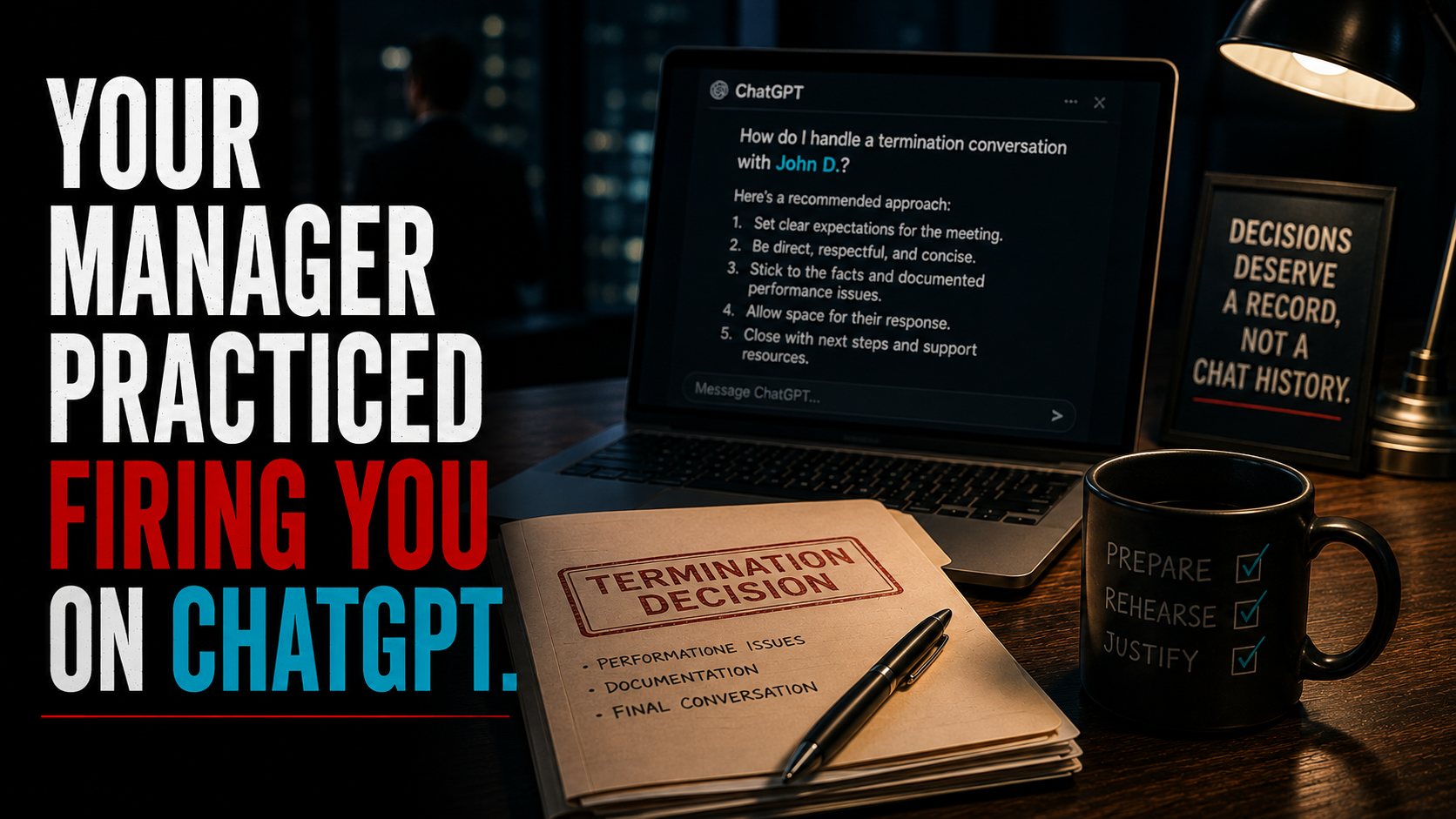
The Predictive Index released a survey last week on how managers get ready for hard conversations. Forty-four percent said they have entered real employee names and performance details into public AI tools.
Not a hypothetical. A person's actual name, typed into a chat window, so a manager could rehearse ending their job.
The reflex is to be angry at the manager. That is the wrong read, and it will cost you more than the behavior does.
The cost
Start with what a termination actually is. It is a decision with a ripple effect that runs through a person's income, their family, their next twelve months, and your team's read on whether this place is fair. It is also the decision most likely to be examined later by someone who was not in the room.
So look at where the reasoning for that decision now lives.
It lives in a session inside a manager's personal account. You do not own it. You cannot produce it. You cannot show anyone how the call was reached, what was weighed, or what was ruled out. If it is ever questioned, what you have is a manager's memory and a paper trail that starts at the outcome.
That is the exposure, and it has nothing to do with the tool being AI. The same problem exists if the reasoning happened in a parking lot conversation nobody wrote down. The tool just made it faster and put it somewhere worse.
Nobody gave the manager a framework
Here is the part leaders skip. In that same survey, only one in five managers said they would rather prepare for a hard conversation on their own, with no framework, no coaching guide, and no input from HR. Four out of five wanted structure.
They went looking for structure. The company did not have any. Fewer than half of the organizations surveyed had a written policy covering AI use in performance management at all.
So the manager found structure somewhere else, in about nine seconds, for free, at eleven at night, without having to admit to anyone that they were nervous about it.
That is not a discipline problem. That is a supply problem. When your people have to make a consequential call and you have handed them nothing to run it through, they will fill the gap with whatever is closest. They always have. The gap-filler used to be a peer in the hallway. Now it is a chat window that answers instantly and keeps a copy.
A mentor who has never met him
There are two roles you can assign an AI. The intern, who you delegate work to and never let send anything unreviewed. The mentor, who advises and pressure-tests but carries zero accountability for the outcome.
Managers are assigning the mentor role here. That part is defensible. The problem is the specific mentor they picked.
A public model has never met the employee. It does not know about the two conversations you already had, the family situation you were working around, the project that went sideways for reasons that were not his. It is trained on broad patterns, which means it produces roughly the same guidance for every manager who asks, about every employee, in every company.
And it will always answer. It will never come back and say this call is not ready to make. We are swimming in answers and we forgot the question.
The question was never how to say this. The question was whether the decision holds up. Those are different problems, and only one of them has a script.
The Pressure Test: The Rehearsal Test
Before your next hard conversation, run these three. They take about five minutes and they work whether or not a machine was involved.
1. Who pushed back on this before it went on the calendar? Name a human being. Not a tool, not your own second pass, not a policy document. If nobody argued the other side, this decision has never actually been tested. It has only been drafted.
2. Where does the reasoning live, and could someone else follow it? Point at it. If a peer read what you wrote down, would they land on the same call for the same reasons? If the answer lives only in your head or in a chat history you do not control, you have an outcome without a decision behind it.
3. What would have changed your mind, and did you go look for it? Name one piece of information that would have made you decide differently. Then say honestly whether you went and checked. If nothing would have changed your mind, you were not deciding. You were confirming.
Anything that fails one of these is not ready for the calendar yet. Anything that clears all three is a defensible decision, structured, recorded, and owned by a person.
The close
The managers in that survey were not being lazy. They were being conscientious without support, which is a harder thing to fix and a worse thing to punish.
Give them a structure and the chat window goes back to being what it should be. A place to work on the wording, after the thinking is already done and written down somewhere you own.
Pressure test before you script. Reasoning before wording. A person owns the call, every time.
If you want a second perspective that actually pushes back instead of agreeing with you, build one. Six questions, and you walk away with a working advisor: https://www.stark-analytics.com/resources/build-your-first-advisor
Originally published in The Decision Brief on LinkedIn.