
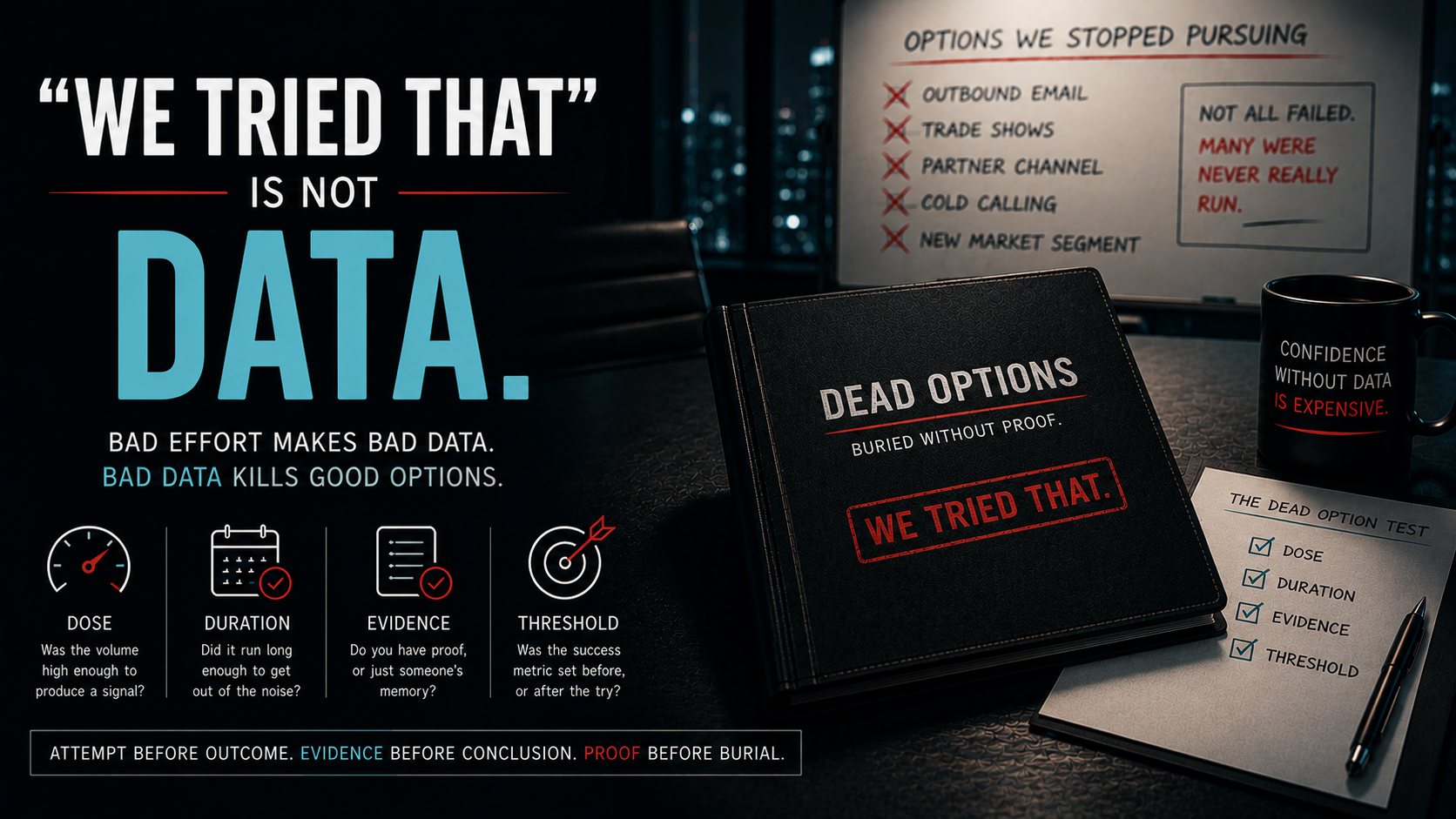
The fastest way to kill a good option is to say four words in a meeting. We tried that.
Nobody asks what "tried" meant. Nobody asks how much, or for how long, or who was actually doing it. The option goes in the ground, and it stays there.
Here is what should bother you about that. "We tried that" is a claim about effort, and effort is the least audited number in your business. Revenue gets audited. Margin gets audited. Headcount gets audited. Effort gets remembered.
The cost
Imagine an operator who decides outbound is dead. They ran a campaign last year and it produced nothing, so outbound comes off the table. The budget shifts to paid ads. The team spends nine months and real money learning a channel they are worse at.
Then someone opens the actual record. The campaign was forty emails over three weeks, sent by a person who already had two other jobs, with no follow up sequence.
That is not a failed channel. That is a channel that was never run.
But the decision that killed it is already downstream in the budget, the roadmap, and the hiring plan. That is the ripple effect in its most expensive form. One unverified input at the front, a year of confident motion in the wrong direction behind it.
The tactic did not fail. The plan was never executed at the dose it required. And the company is now busy solving a problem it does not have.
Bad inputs do not create confusion. They create confidence.
This is the part operators miss. A missing number leaves a hole, and a hole is obvious. A wrong number does not leave a hole. It fills the space with an answer that looks finished.
Say you believe you sent four hundred emails and got two replies. The diagnosis writes itself. The message is weak. Rewrite the copy. Hire a copywriter. Question the positioning. Maybe the whole offer is off.
Now say the truth is forty emails. The diagnosis flips completely. The message was never tested. Nobody did the work.
Same result on the board. Opposite fix. And no dashboard on earth can tell you which situation you are in, because the dashboard cannot see that the four hundred was a story.
This is the reason for saying data-enabled and not data-driven. Data-driven assumes the data is describing what happened and your job is to follow it. Self-reported effort almost never describes what happened. Not because people lie. Because memory rounds up. "We reached out to everyone" means the ones someone remembers. "We gave it a real shot" means it felt like a lot at the time.
Only one of these is a result
There are three different things hiding behind every "we tried that."
It never really ran. The dose was too low to produce a signal, so there was nothing to measure.
It ran, but not long enough. It was cancelled inside the noise, before the thing had a chance to show its shape.
It ran fully, at the intended volume, for the intended time, and it failed.
Only the third one is evidence. The first two are stories about evidence. They feel identical in a meeting, they get delivered with the same confidence, and they carry the same weight in the decision. That is the failure.
And an option killed for the wrong reason does not come back. Nobody reopens the file. It becomes institutional memory, and institutional memory is the hardest data in a company to correct, because nobody thinks of it as data at all. It is just a thing everybody knows.
The Pressure Test: The Dead Option Test
Pick one option your team has already ruled out that would help you right now if it worked. Before you accept the ruling, run it through these four.
1. Dose. What volume, spend, or number of reps was the attempt supposed to involve, and what did it actually involve? If you cannot answer with a number, you do not have a result. You have a feeling with a conclusion attached.
2. Duration. How long did it run before someone called it? Compare that to how long it needed to run before a signal could appear. Most attempts get buried inside the noise and then get blamed for being quiet.
3. Evidence. What proves it happened, other than a person's memory? A send count, a log, a calendar, a ledger, a receipt. If the only record is recollection, treat the whole thing as a hypothesis, not a finding.
4. Threshold. What result was supposed to count as working, and was that number set before the attempt or after it? A threshold invented afterward will always confirm what you already believed. That is not a test. That is a verdict wearing a lab coat.
An option only stays dead if it clears all four. Anything less and you did not test it. You mentioned it.
The close
Every decision you make sits on top of a pile of options you already eliminated. You do not look at that pile. You look at what is left. And you make the call feeling like you have narrowed things down, when what you have actually done is inherit somebody's memory of a Tuesday.
You cannot pressure test a decision when the ground under it is fiction.
Attempt before outcome. Evidence before conclusion. Proof before burial.
The option you buried by mistake is the one your competitor is running right now.
The Dead Option Test checks one option. If you have a real decision you are about to commit to, check the whole thing.
The Decision Pressure-Test is free. Run a real decision through twelve questions it should be able to survive. You leave knowing whether it has been tested enough to make, and exactly where the weak points are.
Originally published in The Decision Brief on LinkedIn.