
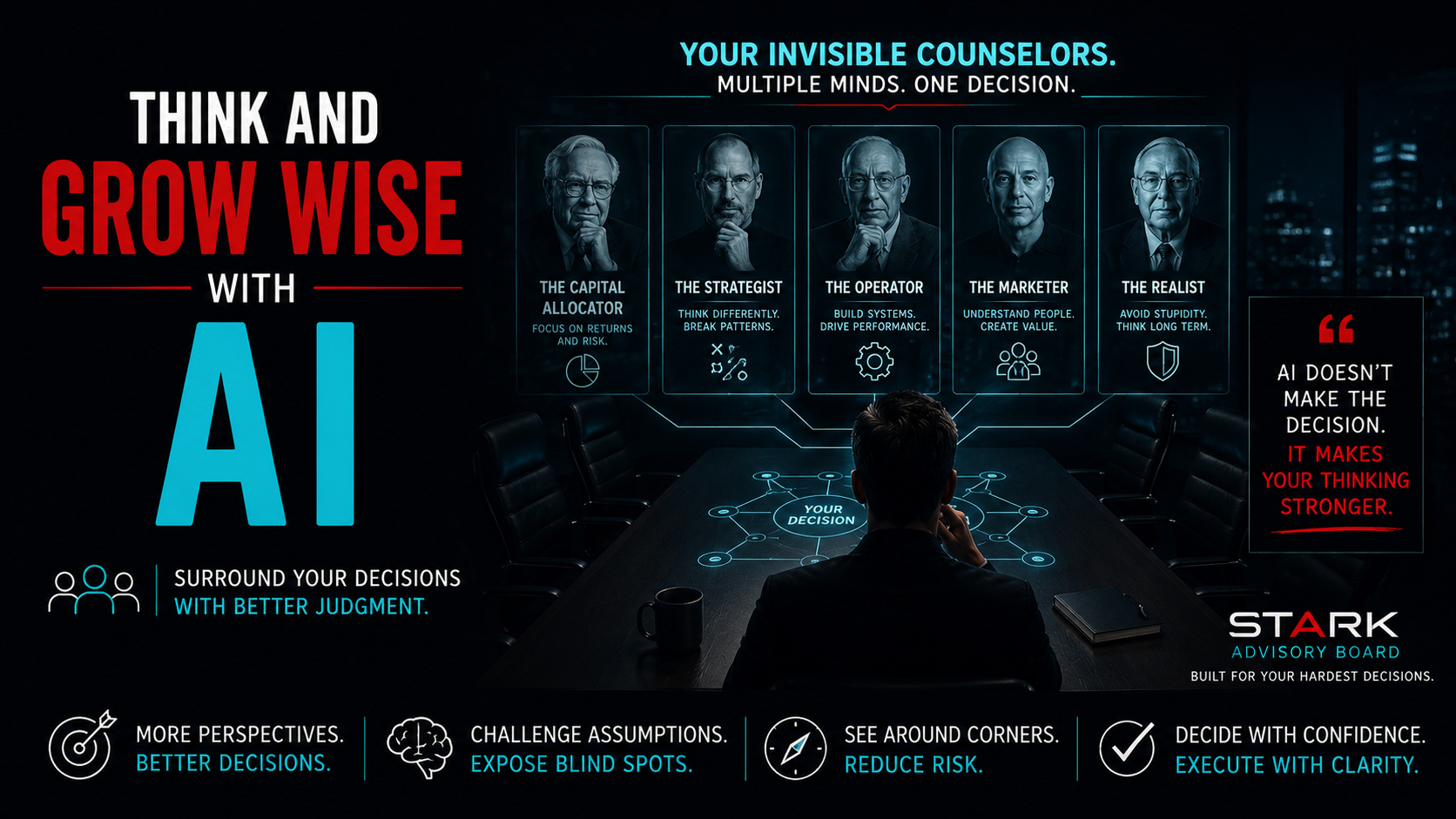
Napoleon Hill wrote about the Invisible Counselors in 1937. The idea was strange, simple, and more practical than people give it credit for: build a private council in your mind made up of the people whose judgment you respect, then bring your hardest questions to that room.
That used to be a mental exercise.
AI makes it operational.
Not literally, and not through affiliation or endorsement. The point is not pretending famous people are sitting inside a chatbot. The point is using AI to research, structure, and apply publicly available thinking patterns from people whose judgment, frameworks, and strategic instincts you would want in the room before you make a real decision.
Used well, AI can become more than a tool that gives you answers. It can become a tactical thought partner that helps you see the decision from angles you would not naturally reach on your own.
The cost
Every operator has a default way of thinking. You have your own instincts, preferences, fears, ambitions, shortcuts, and blind spots. That does not make you weak. It makes you human.
The problem is that operating alone forces one mind to do too many jobs at once. You have to generate the idea, challenge the idea, defend the idea, pressure-test the risk, consider the customer, protect the economics, think through execution, and still make the final call.
That is a lot to ask from one room with one person in it.
This is where AI gets interesting. Not as a vending machine for answers, but as a way to widen the room. You can bring a pricing decision to a capital allocator, a sales strategist, a positioning mind, and an operator. You can bring a launch decision to a marketer, a product thinker, a customer psychologist, and someone who will ask what breaks first if it works.
That kind of tension matters. A good advisory room should not agree too quickly. It should expose the weak assumptions before the market does.
The mistake is building a costume
There is a shallow version of this idea that does not work very well.
You open an AI tool and ask it to "act like" a famous entrepreneur, investor, strategist, or author. The output may sound interesting, but it usually becomes imitation. It borrows the voice, repeats familiar ideas, and gives you the obvious version of the person.
That is not an advisory board. That is a costume.
A stronger version starts with research. What did this person actually write? What did they say across interviews, books, talks, articles, and public frameworks? What did they optimize for? What did they consistently warn against? How did they frame risk, growth, capital, product, attention, leadership, or execution?
That is the difference between a voice and a model.
A voice sounds like someone. A model gives you a structured way to apply how they think.
That matters because the value is not in hearing a familiar tone. The value is in having a specific kind of judgment applied to your specific problem.
Build the room around the decision
The first question is not, "Who would be cool to have in the room?"
The better question is, "What kind of judgment does this decision require?"
A pricing decision may need someone who understands positioning, someone who understands sales psychology, someone who understands margin, and someone who will protect the delivery model. A hiring decision may need a leadership thinker, a systems builder, a culture operator, and someone who is ruthless about opportunity cost.
The board should match the decision.
Once you know the judgment lanes, then you pick the minds. Who would you trust in each lane? Whose thinking lands with you? Whose questions would make you uncomfortable in a useful way? Whose standards would force the decision to get sharper?
That discomfort is part of the value. You are not building a fan club. You are building a pressure-testing room.
The Pressure Test: The Advisory Room Test
Before you use AI as a tactical thought partner, run the decision through this quick test.
1. What decision are you bringing into the room?
Make it specific. "Help me grow" is too vague. "Help me decide whether to narrow my offer, change my audience, or rebuild my sales process" gives the room something real to work with.
2. What types of judgment does this decision need?
Separate the decision into lanes. Strategy, sales, operations, capital, brand, product, customer psychology, leadership, or execution. Do not pick advisors first. Pick the judgment required first.
3. Who would you trust to challenge each lane?
This is where named minds become useful. Not because they are literally involved. Because their public thinking can be studied, structured, and pointed at a decision where that type of judgment matters.
4. What should each advisor be allowed to challenge?
Give each perspective a job. One challenges the economics. One challenges the offer. One challenges the customer promise. One challenges the operational complexity. One challenges whether this is directionally aligned with the business you actually want to build.
5. What decision still belongs to you?
This is the rule that keeps the whole thing honest. The board can challenge, sharpen, simulate, and pressure-test. It can expose blind spots and force better questions. But it does not own the decision.
You do.
AI can expand the room. It cannot carry the consequence.
The close
The best use of AI is not asking it to be smarter than you.
It is using it to make your own thinking harder to fool.
Napoleon Hill had to build his Invisible Counselors in his imagination. You can build a version of that room inside the tools you already use, with more structure, more research, and more pressure than a generic chatbot will ever give you on its own.
The question is not whether AI can give you an answer.
The better question is who you want in the room before you decide.
If this idea is hitting the right nerve, learn more about the Stark Advisory Board. It is a custom-built AI advisory system designed around the specific minds you would want helping you pressure-test your real business decisions.
Originally published in The Decision Brief on LinkedIn.