
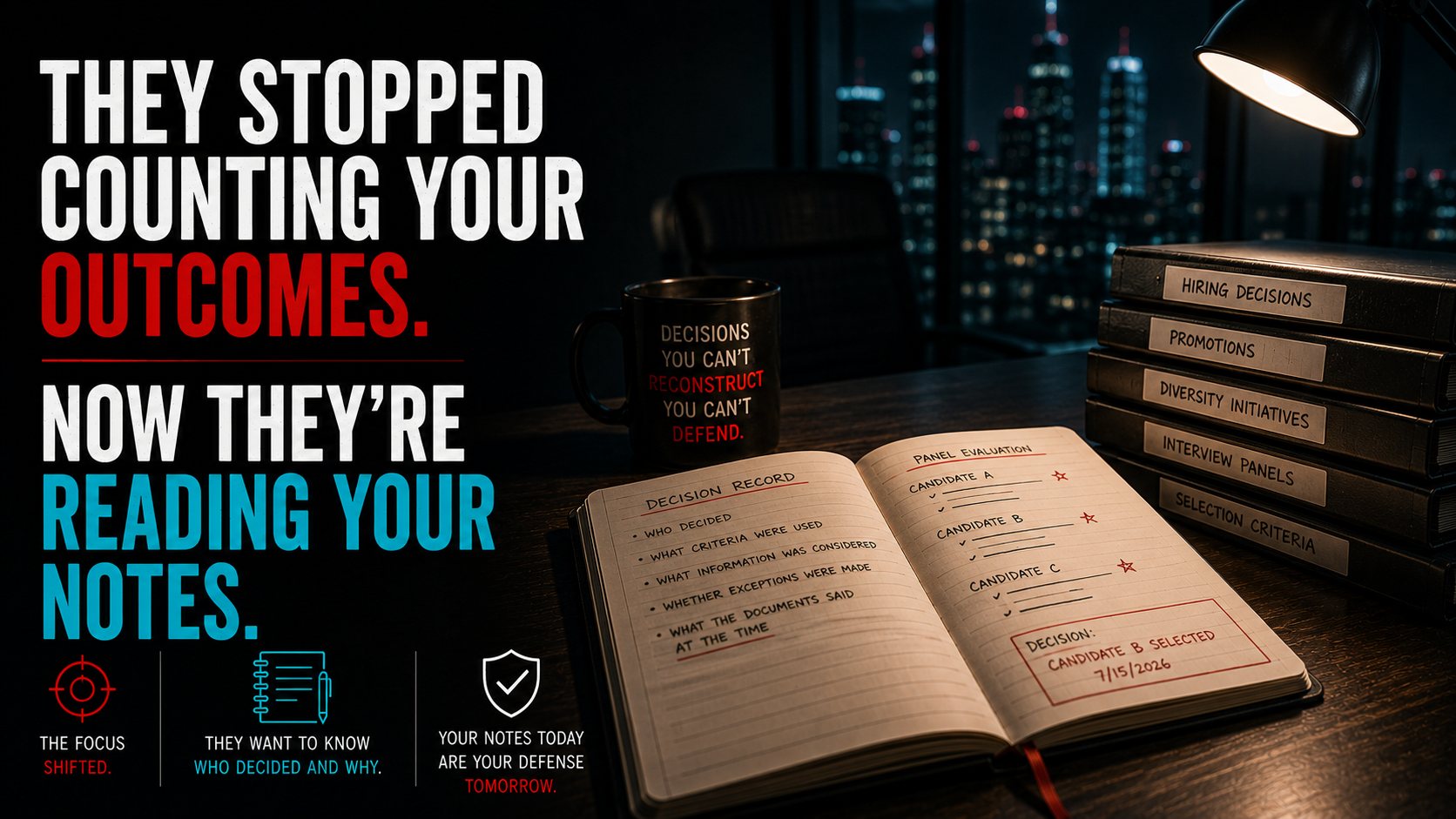
In June, the EEOC released a new National Enforcement Plan, and most operators took one line out of it: the agency will not pursue disparate impact claims. The plan says it plainly. It will eliminate disparate impact liability theories in investigations to the maximum degree possible, and it will not commence, develop, or continue litigation advancing them.
A lot of people read that as the pressure coming off.
It didn't come off. It moved.
The cost
Disparate impact was a claim about numbers. Your process produced an outcome, the outcome skewed, and the statistics did most of the arguing.
The new priority is intentional discrimination, and the plan names the targets directly: hiring and promotion practices, diversity hiring panels, diversity statements, race or sex-based employment goals. That is not a claim about your outcomes. That is a claim about what you were thinking when you decided.
You cannot answer that with a spreadsheet. You answer it with a record.
Jackson Lewis, reading the plan, lays out what employers should now expect to be asked. Who made the decision. What criteria were used. What information was considered. Whether exceptions were made. What the documents said at the time.
Read that list as an operator. Could you produce those five things for your last senior hire? Not reconstruct them. Produce them.
Most companies can produce a job description, an offer letter, and a folder of resumes. That is a record of what happened. It is not a record of how it was decided.
The pressure moved from the outcome to the reasoning
Here is why this is bigger than hiring.
An outcome claim can be answered after the fact. You pull the numbers and build the defense in the months after the charge lands. An intent claim works differently. Intent gets proven or disproven by what existed at the time, which means the defense has to already exist on the day you decide. There is no building it later. There is only having it or not having it.
That moves the work from the back end to the front end.
And nothing here actually got easier. Disparate impact liability did not disappear. One agency stepped back from enforcing it. Private plaintiffs still file, still get right-to-sue letters, and still win in federal court. State law never moved: Illinois amended its Human Rights Act effective January 1, 2026, with a private right of action and penalties reaching $70,000 per violation for repeat offenders. Colorado's AI Act took effect June 30, 2026. California's rules on automated decision systems require four years of records and extend liability to vendors. Mobley v. Workday is still live in the Northern District of California, where the court granted conditional certification of an age-discrimination collective and Workday's own filings put the number of applications rejected through its software at 1.1 billion.
Meanwhile the EEOC's AI hiring guidance came down off the website in January 2025 and is still down. The explainer is gone. The obligations are not.
So the real picture is one fewer federal enforcer, four state standards that do not agree with each other, an active vendor-liability case, and a federal agency now asking who decided and why. Fewer people counting your outcomes. More people reading your notes.
Why most companies fail this quietly
Ask a leadership team how they made their last important hire and you get a story. Confident, coherent, assembled after the fact.
We liked her communication. He wasn't a culture fit. She just felt more ready.
That is memory, and memory reorganizes itself around the outcome. If the hire worked, the room remembers why it was obviously right. If it failed, the same room remembers doubts nobody actually voiced.
A receipt and a story about buying something are two different objects. Only one of them holds up.
The legal version is just the loudest version. The same gap sits under every serious decision in the business. The choice gets made in a room, the reasoning stays in people's heads, and six months later nobody can say why the winner won over the runner-up. A regulator is only the first party rude enough to ask out loud.
The Pressure Test: The Reconstruction Test
Take one decision you made in the last ninety days that mattered. A hire, a vendor, a pricing change, a service line you killed. Run three questions.
- Who decided? Name the people who evaluated and the person who made the call. Not "leadership." Not "we." If the answer is the room, there was no owner.
- What criteria existed before you saw the options? Written down in advance, or assembled afterward to explain the choice you already liked?
- Why did the winner win over the runner-up? One sentence, specific to those two, written at the time rather than now.
Then the rule that makes it a test: if you are answering from memory, you don't have a record. You have a story.
Run it on three decisions. The pattern shows up fast, and it will not be flattering. That is the point. It is a diagnostic, not a grade.
The close
A record does not hand the decision to a machine. It does the reverse. It is the proof that a human evaluated, weighed, and chose, on criteria they were willing to write down before they knew who would win. The system holds the record. The person holds the judgment.
That is what defensible decisions actually means. Not decisions that turned out right. Decisions you can reconstruct.
Because a decision you can't reconstruct is a decision you can't defend. Not to a regulator, not to a plaintiff, not to a board, and not to the version of you that has to answer for it two years from now.
If panel hires are the decisions you would least want to reconstruct from memory, TruGem was built for exactly that. Independent anonymous scoring, sharp disagreement surfaced before the offer goes out, and a permanent record of who evaluated and on what criteria. Humans decide. The system just remembers honestly. Thirty-minute demonstration at trugemtalent.com.
Originally published in The Decision Brief on LinkedIn.