
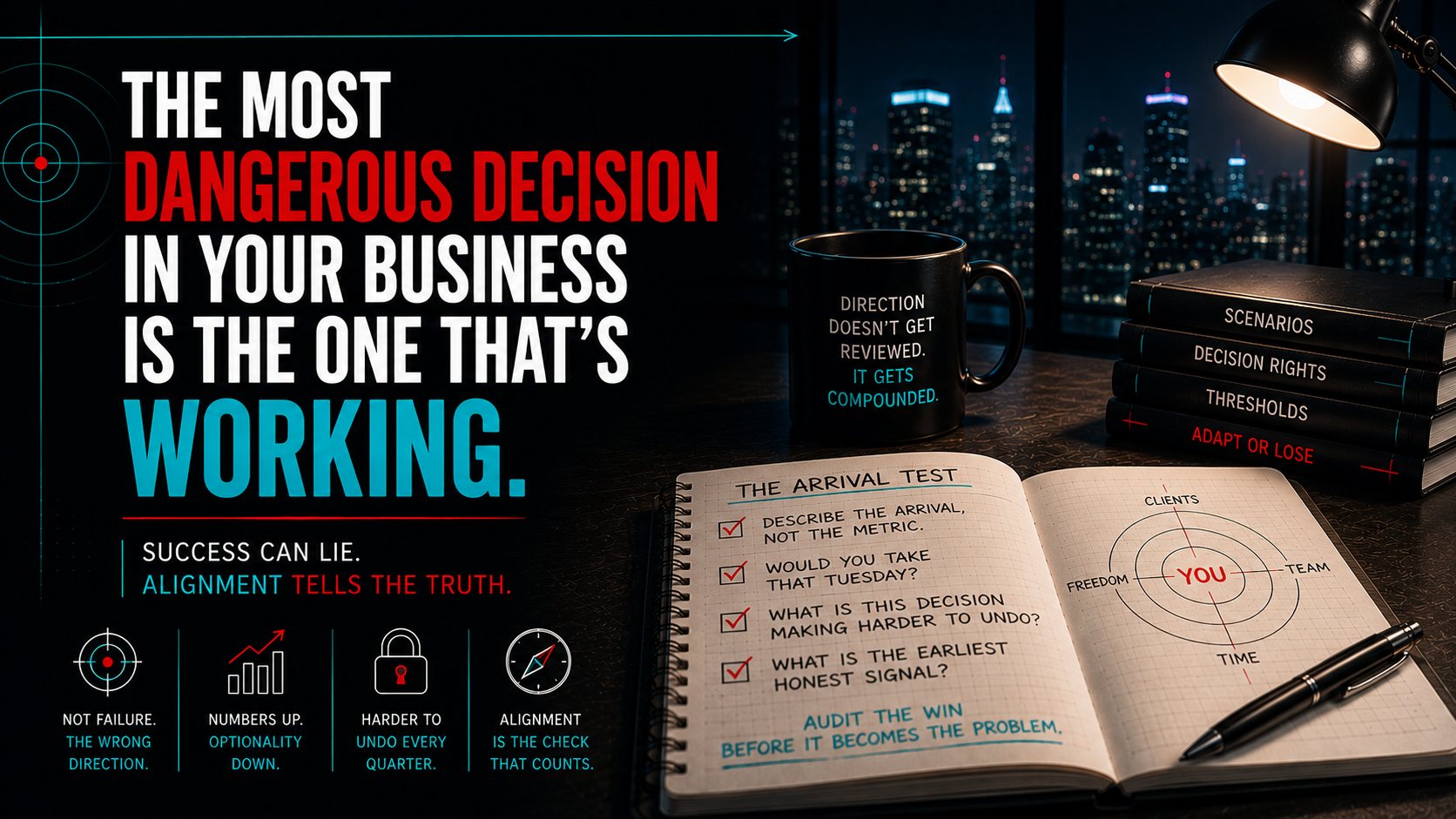
Operators routinely audit their failures. Almost none of them audit their wins.
That is where the expensive mistakes live, because a decision that is working and a decision that was right are not the same thing, and nothing forces you to tell them apart while the numbers look good.
The cost
Failure has one useful property. It makes you go back and look.
When a launch flops or a hire washes out, somebody asks what happened. The assumptions get pulled apart. It is uncomfortable, but the business learns something.
Success shuts that door. Revenue is up, the plan is on track, so the decision behind it gets filed as correct and never opened again. The team celebrates and moves on.
Meanwhile the business is being quietly built into a shape nobody chose.
Imagine an operator who decides to chase larger enterprise clients. It works. The contracts are bigger, revenue climbs, the logos look great on the site. Eighteen months later the business has a six-month sales cycle, three people who exist mainly to service procurement, a founder who spends most of the week in meetings instead of building, and a concentration risk where two clients are half the revenue.
Nothing failed. Every quarter hit. And the operator now runs a company they would not have chosen if someone had described it to them in advance.
That is the ripple effect of a decision that was executed well and pointed wrong. It does not announce itself, because every individual quarter looked like a win.
Why nobody catches it
Execution quality gets measured against the plan. It never gets measured against the direction.
So the review question is always some version of "are we hitting the number," and the answer keeps coming back yes. The question that would catch the problem, whether the number is carrying you somewhere you want to end up, has no natural home on the calendar.
It also does not feel urgent. A directionally wrong decision that is performing well creates no pressure. No crisis, no fire, nothing broken. It just compounds, and every quarter of good execution makes it more expensive to reverse.
Christian Torres encountered this personally. Years ago he was climbing toward a Director of Operations role and executing it well before he stopped long enough to notice he did not actually want to manage people. The plan was working. The plan was also carrying him somewhere he had never decided to go.
You can be wrong at full speed. Speed just makes it harder to see.
This is what Align was built for
In the DARK Method, the A is Align with Direction. It is the discipline that gets skipped most often, because it feels philosophical next to the concrete work of defining options and running numbers.
It is not philosophical. It is the check that asks whether a decision that is optimal inside its own frame is still directionally aligned with the business you are trying to build and the way you want to spend your life running it.
A decision can be internally perfect and still fail that test. Good margin, clean execution, happy client, wrong direction. Those are the ones that hurt, because nothing in the operating rhythm is designed to flag them.
The Pressure Test: The Arrival Test
Run this on a decision that is currently working. Not one that is struggling. The whole point is to audit a win.
1. Describe the arrival, not the metric.
If this decision works exactly as planned, what does an ordinary Tuesday look like eighteen months from now? Who is on the team, what are you personally doing between nine and five, what kind of clients are you serving, what does the work actually feel like?
Metrics are easy to say yes to. Tuesdays are harder.
2. Would you take that Tuesday?
If the honest answer is "mostly," name the part you would not take. Say it out loud.
That part is not a risk. It is already in the plan. You are not predicting it, you are reading it off the decision you already made.
3. What is this decision making harder to undo?
Every commitment buys momentum and spends optionality. Name what is getting locked: a cost structure, a client concentration, a delivery model, a team shape, a reputation in a market you were only testing.
If it becomes clear in a year that this was wrong, what will it cost to turn around? That number is the real price of the decision, and it is almost never in the projection.
4. What is the earliest honest signal?
Not the lagging financial metric. Those arrive last. The early signals are behavioral: the client you would fire if you could afford to, the part of the week you keep rescheduling, the work you used to do yourself that you now avoid.
Name one now, while you are calm, and write down what you will do when you see it. Signals you name in advance are useful. Signals you notice in the moment get explained away.
The close
There is a version of this business that hits every number you have written down and leaves you running something you do not want to run. That version is not a failure scenario. It is the success scenario, arriving on schedule.
Failure gets audited. Success gets celebrated. Only one of those is a decision review, and it is the wrong one.
So put a win on the table this quarter and pressure-test it like it went badly.
You can succeed at the wrong thing. Most people do it on time and under budget.
Originally published in The Decision Brief on LinkedIn.