
Hiring for a critical role is the highest-stakes decision most teams make with the least structure.
Think about the gap. A $500,000 equipment purchase gets a business case, three quotes, and a signature trail. A senior hire that will shape the culture, the numbers, and a dozen other careers gets five interviews, a group conversation, and a gut call nobody wrote down.
The bad hire is rarely a bad candidate. It is usually a good process that fails at one specific moment. And the failure leaves no trace, which is the part that costs you twice.
The cost
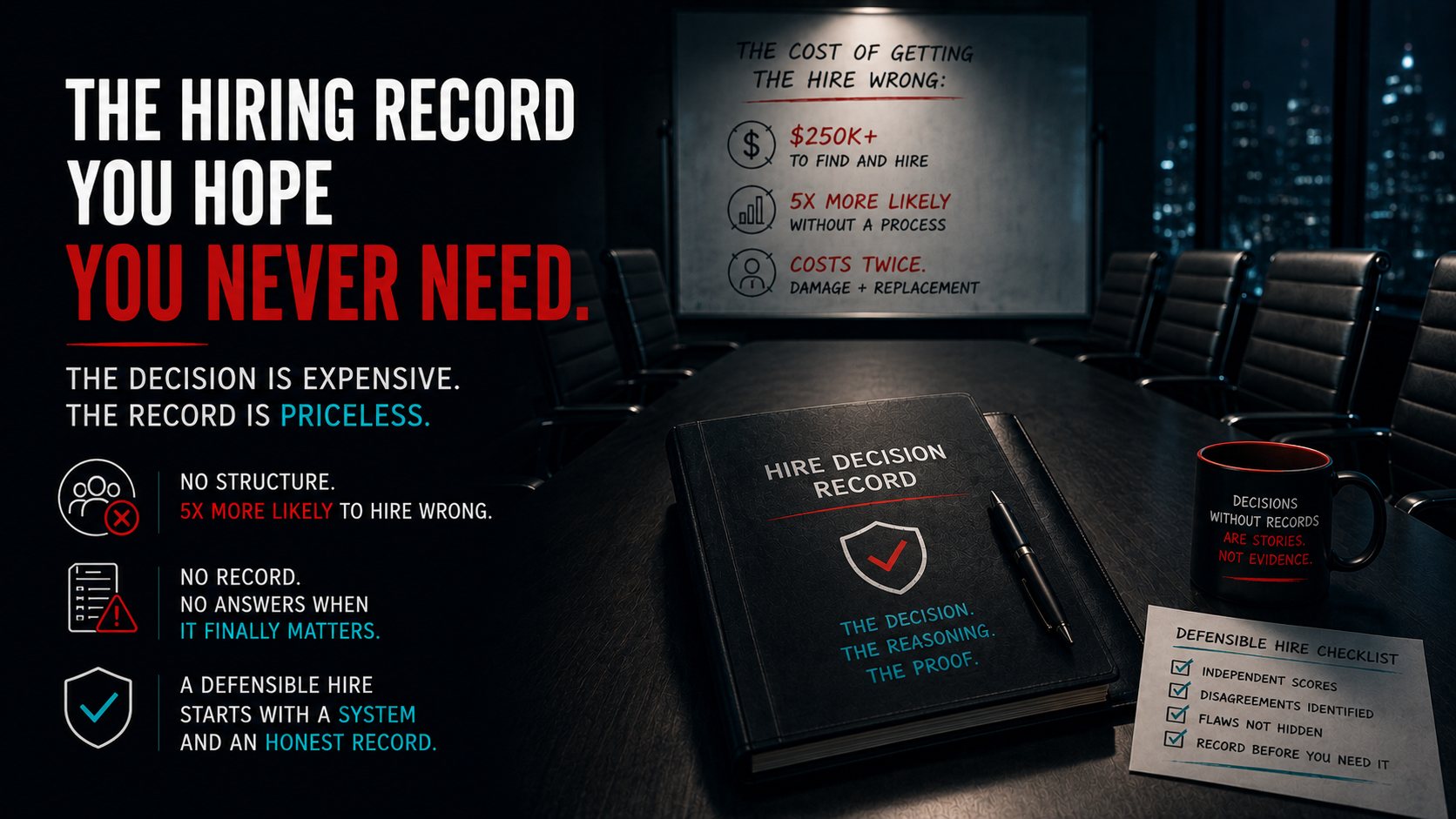
Start with the number, because it is worse than people assume. SHRM reports that it can cost more than a quarter of a million dollars just to find and hire a new employee. Get the choice wrong and you pay for it twice: once to carry the damage while the wrong person sits in the seat, and again to find and hire the replacement.
Here is the part that should stop you. SHRM also points to research showing that organizations without a standardized process are five times more likely to make a bad hire than the ones that have it. Five times. The gap between a good hire and an expensive mistake is not mainly the candidate. It is whether there was a real process under the decision.
The dollar figure and the odds are the visible costs. The invisible one is worse.
A year later, something goes wrong. The hire is not working out, or a passed-over candidate files a complaint. Someone asks the simple question: how did we decide?
And you cannot really answer. The scorecards, if they existed, sit in six inboxes. The reasoning lived in people's heads, and half of those people have moved on. You made a six-figure decision and kept no record of why.
That is the hiring record you hope you never need. You only feel its absence on the day you finally need it.
Your ATS did its job. The decision starts after it stops.
This is the distinction most teams miss. The applicant tracking system is not the decision. It is the pipeline.
An ATS posts the role, collects the resumes, and filters fifty applicants down to a short list of five real candidates. That is screening, and the software is good at it. It tells you where a candidate sits in the process. It does not tell you whether your panel actually agreed, or why you chose the one you chose.
Everything upstream of the short list is a filtering problem. Everything downstream is a decision problem. And the moment you cross from one to the other, the structure disappears. The ATS hands you five finalists and goes quiet. From there it is a room full of smart people, a stack of impressions, and a decision this expensive made the least rigorous way it will be made all year.
Three things go wrong in the debrief
Watch what actually happens when the panel sits down to compare notes.
The high score hides the flaw. One candidate averages a strong 4.3, so they win. Nobody notices the 2.5 buried underneath on the single dimension that will actually break the role. Averaging is comfortable. It is also how you hire a brilliant presenter who cannot run the team.
The disagreement gets erased. Two reviewers split hard on a candidate, one high, one low. The group lands on a polite middle that represents nobody's real view. That split was the signal. It was the panel telling you something needed a harder look, and the average deleted it.
The loudest voice wins. Rank, volume, and confidence fill the vacuum that structure was supposed to fill. The most senior person in the room speaks first, and the scores quietly rearrange themselves to agree. That is not alignment. That is deference, and it looks just like agreement from the outside.
None of this means your people are careless. It means the format has predictable failure modes, and hope is not a control for any of them.
The Pressure Test: The Defensible Hire Test
Before your next critical offer goes out, run the decision through these four questions. Not the candidate. The decision.
1. Did every reviewer score independently, or did the room converge on whoever spoke first?
If your scores were formed in the meeting instead of before it, you measured social pressure, not the candidate.
2. Where did the panel actually disagree, and did you talk about it, or did the average smooth it over?
Find the split. The split is where the real risk is hiding.
3. Is there a strong overall score sitting on top of one specific weakness nobody flagged out loud?
Pull the top candidate's dimensions apart. A 4.3 with a 2.5 underneath is not a 4.3.
4. If someone asked you a year from now how and why you chose, could you show them, or would you be reconstructing it from memory?
If the honest answer is reconstructing, you do not have a decision on record. You have a story you will tell later and hope it holds up.
If those questions make you uncomfortable, good. That discomfort is far cheaper today than it is in a wrongful-hire review, a board question, or a turnover post-mortem eighteen months from now.
The close
Data can be shaped to justify almost any hire after the fact. An honest record made before the outcome is known cannot be shaped, because it was written before anyone knew they would need it.
That is the point of a system of record. Not to slow the decision down. It is so that when the decision gets questioned, and the important ones always are, you can stand behind it with more than a memory and a good feeling.
Structure before the meeting. Honesty over the comfortable average. A record before you need it.
Hiring is where a lot of companies bleed out invisibly. It does not have to be.
Christian Torres built TruGem because he needed this tool and could not find it. It sits exactly where the ATS stops: after the short list, at the panel decision. Reviewers score independently and anonymously, it surfaces the disagreement and the buried flaws instead of averaging them away, and it produces one permanent, defensible record of how the hire was made. If you want to see it run on one of your real open roles, Stark Analytics can show you.
www.trugemtalent.com
Originally published in The Decision Brief on LinkedIn.