
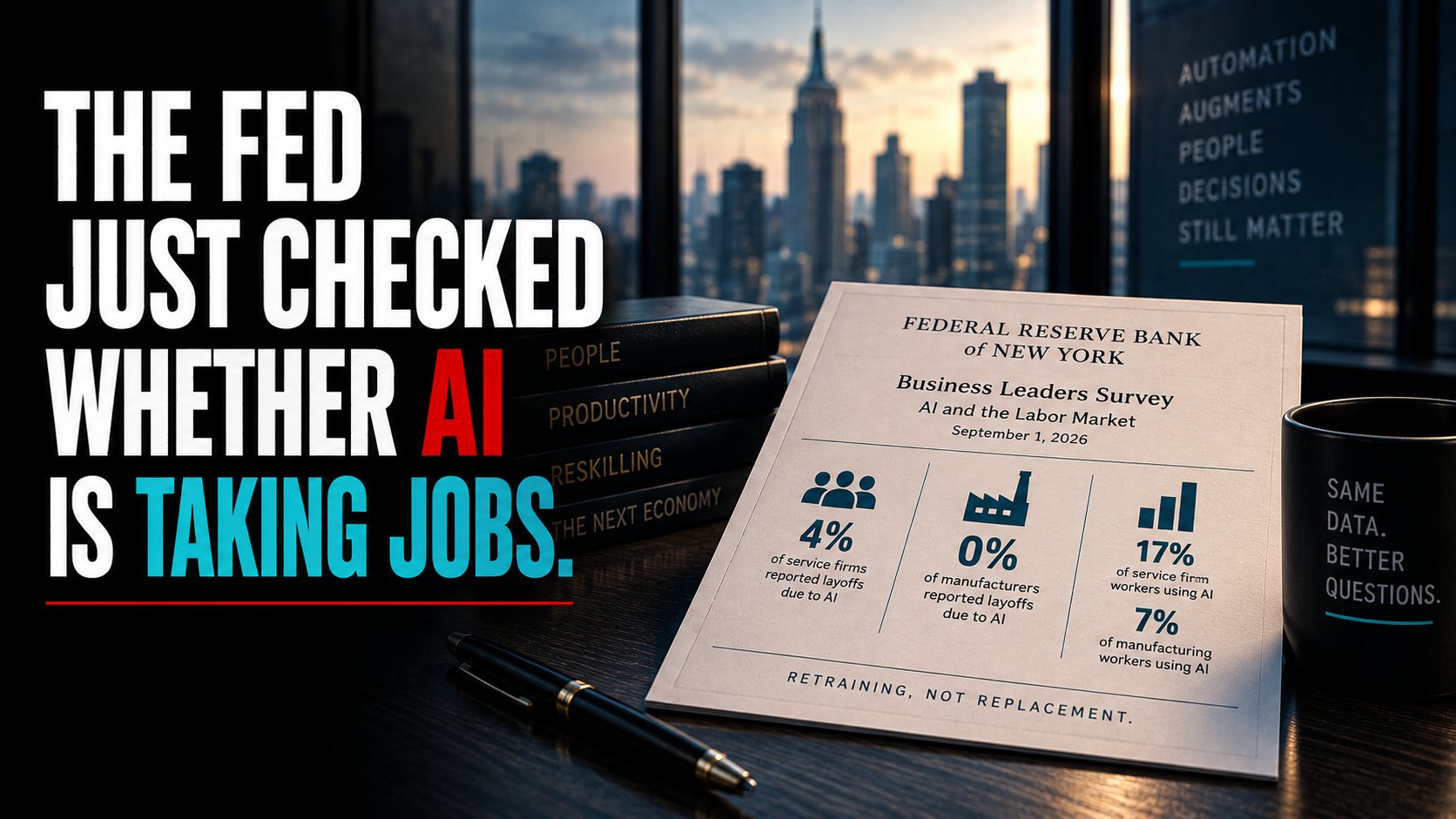
The Federal Reserve Bank of New York published new survey results on September 1. Three years of data from businesses across New York and Northern New Jersey, asking the question everyone keeps arguing about. Is AI cutting jobs?
Their answer, so far: mostly no. Four percent of service firms reported layoffs due to AI in the past six months. No manufacturers reported any. Retraining is the common response, not replacement.
That finding is going to get shared all week as relief. Read one more line before you take it.
Among the firms that use AI, the median share of workers actually using it was 17 percent at service firms and 7 percent at manufacturers.
The cost
Nobody is cutting jobs because almost nobody has put the technology to work yet.
That is a different sentence than the one people are going to quote, and it points at a different set of decisions.
If you read the layoff number and conclude that AI is overhyped and you have time, you have just made a real decision. You slowed a training budget. You deferred building a record of how your team decides. You told yourself the pressure is not coming.
You made that call on a number that measured deployment, not capability. It is the equivalent of checking the thermometer to find out which way the wind is blowing. The instrument works fine. It is answering a different question than the one you have.
What the survey actually measured
Adoption in this survey means the tool is in the business. It does not mean the work changed.
Look at the picture the Fed put together. Adoption climbed steeply, with 61 percent of service firms and 51 percent of manufacturers now using AI, both up sharply from last year. And at the same time, three quarters of service firms and more than 90 percent of manufacturers described their AI investment as minimal to modest, ranging from free tools to a small slice of spending.
Broad, and about an inch deep. For a lot of companies, "we use AI" means two people in marketing and somebody in accounts payable.
Two more things belong in an honest read. This is a regional survey, not a national one. And the Fed's own post points to Stanford research suggesting entry-level workers are already being affected, because AI substitutes well for the routine tasks new people usually cut their teeth on. So even inside the good news, there is a group already feeling it.
None of that makes the study wrong. It makes it narrow. Which is what every study is.
Comfort is the most expensive data you will read this year
Here is the recurring pattern. A number that challenges someone gets audited line by line. A number that lets them off the hook gets forwarded.
We are swimming in answers, and the ones we keep are the ones that already agree with us. That is not a data problem. There has never been more data. It is a decision problem, and it is the reason two companies can read the same report and walk out with opposite plans.
The operators who get hurt over the next two years will not be the ones who read this study. They will be the ones who read it, felt better, and stopped there.
The Pressure Test: The Comfort Check
Run this on any number that makes you feel better about a decision you were nervous about. It takes about four minutes.
1. What was actually measured, and is that your question? Write the survey's question and your question side by side. If they are not the same sentence, the number does not settle your issue. It just changed the subject in a way you enjoyed.
2. Were you in the sample? Region, industry, company size, time period. A finding about manufacturers in Northern New Jersey in August is a real finding about manufacturers in Northern New Jersey in August. Ask honestly whether you were in the room.
3. What would have to stay true for this to hold in twelve months? Name the conditions. In this case, it holds as long as deployment stays shallow and investment stays modest. Both of those are things your competitors get to change without telling you.
The rule underneath all three: a number that agrees with you gets more scrutiny, not less. Reverse the instinct and you will catch most of your own blind spots before the market does.
The close
The Fed did careful work here, and the honest read is genuinely reassuring about the present. It says almost nothing about the next eighteen months, because it was never built to.
Data does not make decisions. It narrows the range a person has to judge inside. The whole job is knowing what a number can and cannot carry, and then owning the call anyway.
Read the number. Ask what it measured. Decide like the answer is still yours.
Every operator has a blind spot in how they read their own situation. Find yours in about five minutes: https://www.stark-analytics.com/resources/blind-spot-test
Originally published in The Decision Brief on LinkedIn.