You have probably been sitting on a decision because you are waiting on a little more information. That feels responsible.
The call sits another week because the picture is not complete yet. More data is coming. One more conversation. Then we will know. But the picture is never complete, and the waiting is not diligence. It is avoidance in a better suit.
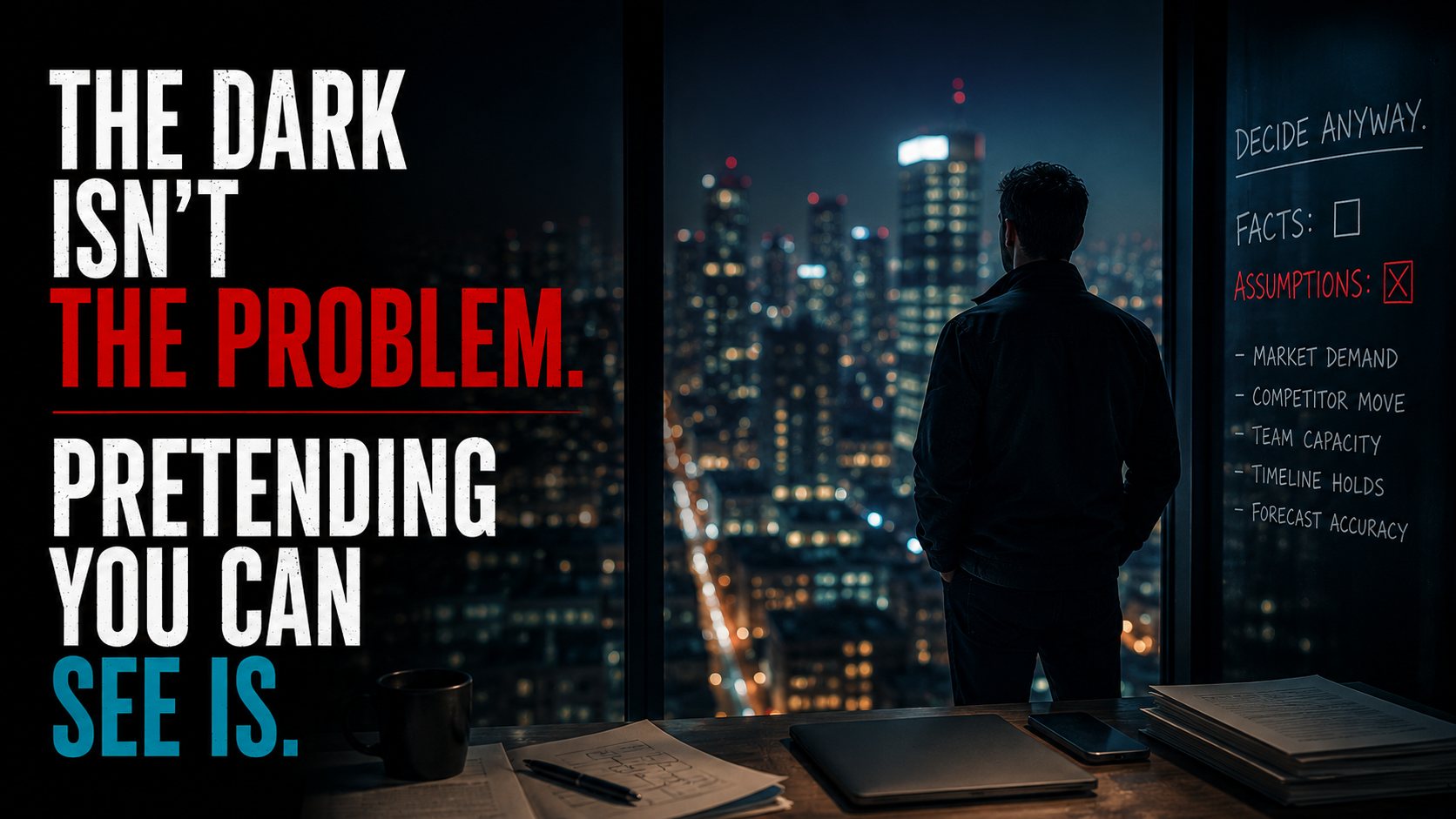
Here is what most people miss. Every decision worth making gets made in the dark. That is not a failure state. That is the normal operating condition of running a business. The leaders who accept it move faster and defend better than the ones still waiting for the fog to lift.
The cost
The obvious cost of waiting is the delay. That is the part people argue about in meetings, and it is the smaller half.
The real cost is that you stop labeling your inputs.
When you believe the picture is almost complete, assumptions get promoted to facts and nobody notices the paperwork. The forecast becomes the number. The vendor's timeline becomes the timeline. The one customer who told you what they wanted becomes the market. Nobody lied and nobody got sloppy. The information just quietly changed status on the way into the decision.
So the call gets made on a blend of things you know and things you assumed, with no way to separate them afterward. If it works, you learn nothing. If it breaks, you cannot tell which input failed. You just know it broke, and you go into the next decision carrying the same unlabeled mix.
Assumptions do not announce themselves
This is the part that makes fog dangerous instead of just annoying.
A fact and an assumption feel identical inside your head. They arrive in the same voice. They sit in the same slide. Ask a room where a number came from and watch how often the answer is a name instead of a source. Somebody said it in a meeting eight weeks ago, it got repeated, and repetition did the rest.
Think about a spreadsheet. Every cell looks the same on screen. Some of them are typed values and some of them are formulas pulling from somewhere else, and you cannot tell which is which until you click in. A decision works the same way. Two inputs can look equally solid, and one of them is holding up the whole decision while the other is a guess somebody typed in once.
The fix is not more certainty. The fix is knowing which cells are typed and which are pulling.
More information is not the same as a different decision
Most of what gets gathered before a big call would not have changed the call.
That is the uncomfortable test. Before you go get the next report, name the finding that would flip you. If you cannot name one, you are not researching. You are building cover. You want the record to show you looked hard, and looking hard feels close enough to deciding well that most people never notice the swap.
Running it through a model does not solve this either. A tool can pressure-test your logic and it should. But feeding an assumption into better analysis returns a more confident version of the same assumption. The machine cannot tell you which of your inputs were guesses. Only you know that, and only if you wrote it down.
The Pressure Test: The Visibility Line
Take one decision you are sitting on right now. Draw a line down the middle of a page. Three passes.
1. What do you actually know? Left side. Only what you could point to a source for. A signed contract, a shipped number, a documented conversation. If the source is a person's confidence rather than a document, it does not go here.
2. What are you treating as known? Right side. Everything else. The forecast. The assumed timeline. What you believe your competitor will do. What you think your team can absorb. This side is almost always longer than people expect, and the length is the point.
3. What would move the line, and can you get it in time? Pick the single item on the right that would most change the decision if it moved to the left. Name what would move it. Then ask whether you can get that before the decision expires. If yes, go get it and only that. If no, you have your answer: this is a decision you make in the dark, on purpose, with the assumptions labeled.
Run it again next quarter on the same decision. The line moves. That is the record.
The close
Deciding in the dark is not recklessness. Recklessness is deciding in the dark and telling yourself the lights are on.
You will never have the whole picture. You can always know which part of the picture you are making up. That is the difference between a decision you own and a decision that happened to you.
Name what you know. Name what you are guessing. Then decide anyway.
The book is Built in the Dark. If the idea above is useful, that is where the rest of it lives: https://www.christiantorres.info/builtinthedark
Originally published in The Decision Brief on LinkedIn.