
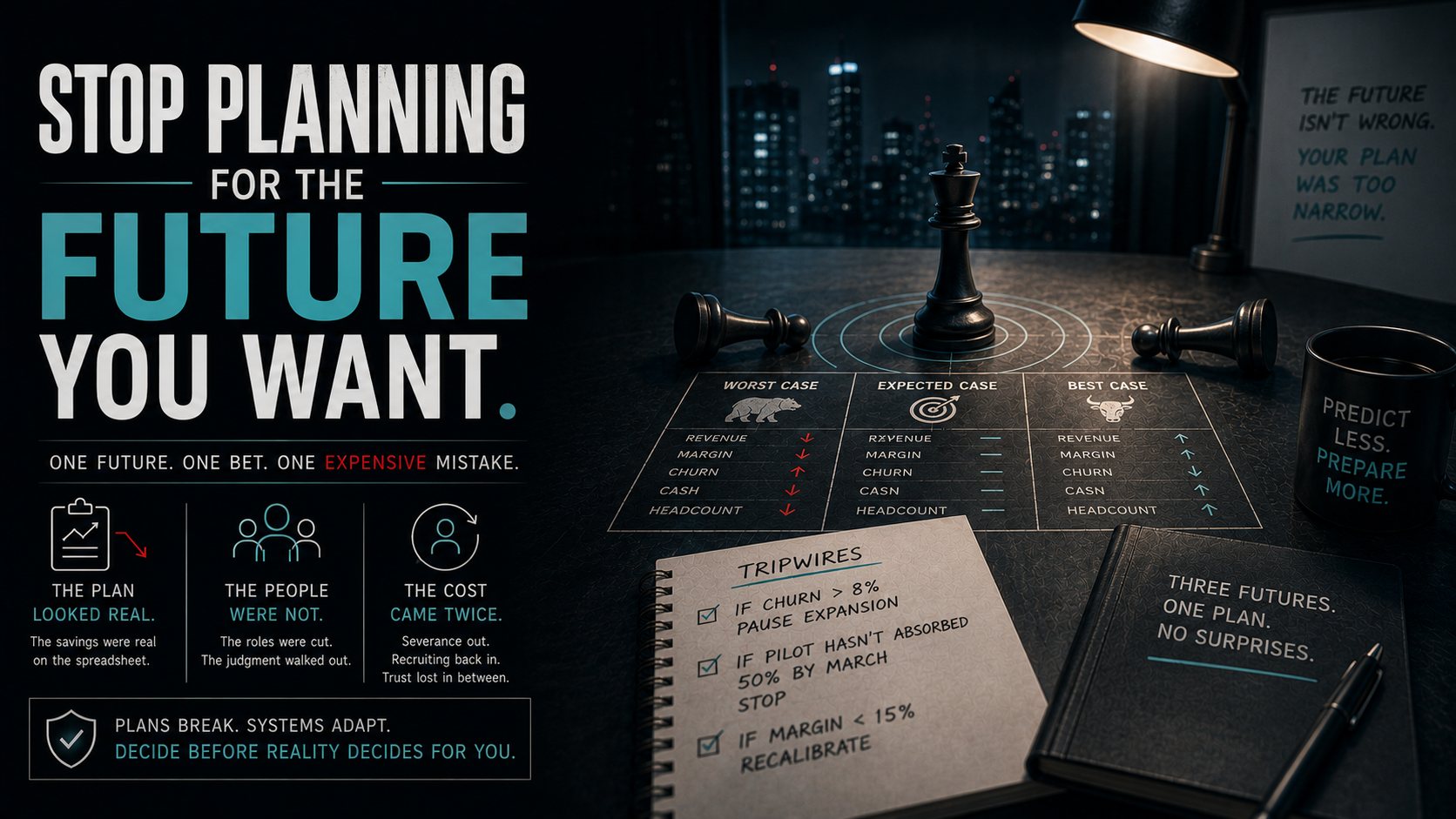
Every company quietly rehiring the people it laid off for AI made the same mistake. They planned for the AI they wanted, not the AI they got.
The tools were real. The savings looked real on the spreadsheet. The failure was upstream of the technology: one version of the future got written down, funded, and announced, and every other version got treated like a rounding error.
The cost
The numbers behind this are current, and they are not small. Challenger, Gray & Christmas reports that AI has led all cited reasons for U.S. job cuts for four consecutive months. Through June, employers have attributed 101,743 announced cuts to AI this year, about 23% of all cuts. And across the same stretch, business reporting from CNBC, Forbes, and others has been documenting the other half of the story. A growing number of those same employers are rehiring for roles they eliminated, some within months, because the tools handled the tasks and nobody was left to carry the judgment.
Play out what that sequence actually costs. Severance on the way out. Recruiting, salaries, and ramp-up time on the way back in. Institutional knowledge that left the building and did not return. A team that watched all of it and quietly updated what your promises are worth. That is the cost of a bad decision, paid twice for the same call.
Now remove AI from the story. It still stands. Swap in a tariff schedule, a lost anchor client, a rate change, a key resignation. Any operator who builds one confident plan on one expected future is exposed to the same bill. AI did not invent this failure. It just produced a very public season of it.
A plan built on one future is a hardcoded cell
In a working financial model, the cells that matter hold formulas. Change an input and the sheet recalculates, because the model was built knowing the inputs would move. A plan built on a single future is a hardcoded number sitting in a cell that should hold a formula. It looks clean. It presents well. And the moment reality changes an input, the sheet stops telling the truth, and nobody notices, because the number still looks confident.
Operators do this for an understandable reason. Certainty feels like leadership. One decisive plan is easier to sell to a team, a bank, or a board than three futures and a set of tripwires. But certainty is a costume that assumptions wear. The companies that cut deepest on AI were not the ones with the best information. They were the ones most certain about a technology that even its builders describe in probabilities.
You do not need to be certain. You need to be directionally aligned, with a plan that survives being wrong.
Thresholds get decided before the pressure, or not at all
Planning in ranges sounds academic until you see how practical it is. Take the decision in front of you and write down three futures instead of one: the expected case, a better case, and a worse case. You are not trying to be right about which one happens. You are making sure none of them finds you unprepared.
Then do the part almost everyone skips. Decide, in advance, what would make you change course. A number. A date. An event. If churn passes eight percent, we pause the expansion. If the pilot has not absorbed half the workload by March, we stop pretending it will by June.
A threshold set before the pressure arrives is a decision. A threshold set during the pressure is a negotiation, and you will be negotiating against your own sunk costs, your own public statements, and your own ego. That negotiation rarely goes well. The companies now rehiring did not lack data. They lacked a tripwire they had agreed to honor before the announcement went out.
The Pressure Test: The Range Check
Take one live decision, one you are actually facing this quarter, and run it through three questions before you commit.
1. What future is this plan betting on? Say it out loud in one sentence: "This plan works if..." If you have never finished that sentence, the bet is hidden, and hidden bets are the expensive kind.
2. What are the two futures you are not planning for? One better than expected, one worse. Sketch what each would demand from you. And give the better case the same scrutiny as the worse one: if everything goes right, what breaks first? Ten minutes of rehearsal now beats ten weeks of improvisation later.
3. What would make you change course, and are you choosing it now? Name the number, date, or event that triggers a move, and write it down where your team can see it. If you wait for the storm to pick your threshold, it will pick one you cannot afford.
If you can answer all three, you have a plan with a range. If you cannot, you have a prediction with a budget attached.
The close
The operators who came through this year's whiplash in decent shape were not better forecasters. They had already decided what they would do when the forecast broke.
Stop trying to predict what the market is going to do. Decide what you are going to do when it does.
If you suspect your planning runs more on momentum than on design, take the free Decision System Self-Audit. Eight statements, about five minutes, one honest score. It will tell you whether the decision system you are running is accidental, inconsistent, or deliberate.
Originally published in The Decision Brief on LinkedIn.