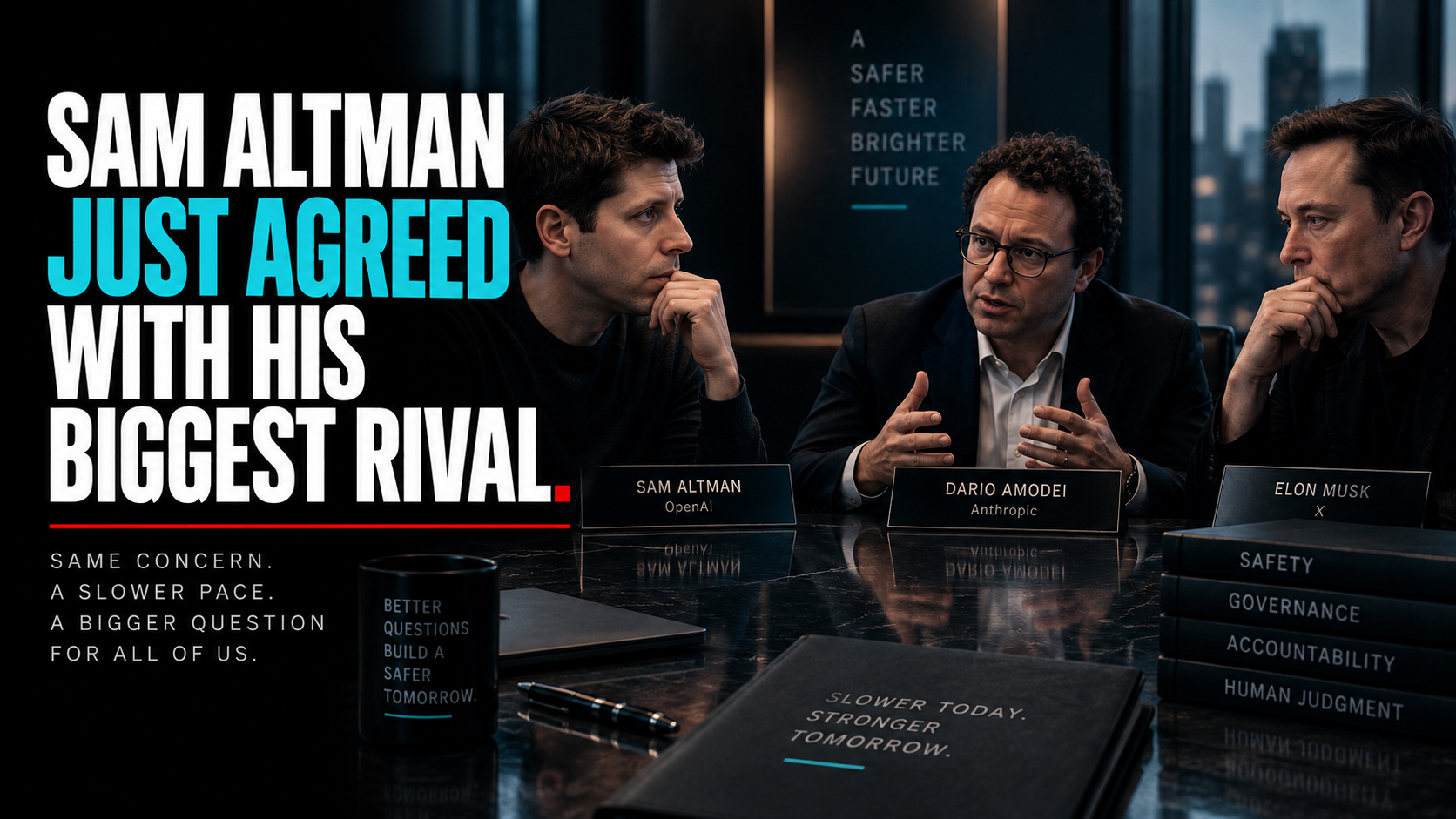
On Saturday, September 12, Anthropic CEO Dario Amodei published an essay of roughly 3,900 words asking the AI industry to slow down. Not stop. Slow the pace of capability development so the safety work has time to catch up.
Sam Altman posted that he agreed with Dario. Elon Musk added his own warning the same day. Altman also told Fortune that OpenAI would not go public in 2026. Two days later, the semiconductor index had its worst session since July.
The people who compete hardest in this industry just agreed on one thing. They do not fully trust themselves to grade their own work.
That should change how you make your next big decision.
The cost
Look at what Amodei actually proposed. The first step, which Anthropic committed to right away, puts outside evaluators inside the company with the same access as regular staff. Internal systems, model training, and whether the safety rules are being followed. Not a summary deck. The real thing.
Think about why a CEO would volunteer for that. It is slow, it is expensive, and it hands an outsider the right to tell you something you do not want to hear. He did it because the stakes got high enough that his own judgment, however good, was not enough by itself.
Now look at how a lot of mid-market companies make their biggest calls. The owner decides. A couple of trusted people weigh in, and most of them report to the owner. Nobody outside the decision sees the real numbers before it is final. More and more, the second opinion is a chatbot that agrees with whatever you brought it.
The cost of that setup never shows up as a line item. It shows up as the acquisition that looked obvious, the hire everyone was excited about, the expansion that made sense in the room. Decisions nobody pushed on until it was too late to matter.
Pacing is a different thing than stopping
The loudest reaction to all this will be that AI is dangerous and you should wait. That misses what the labs actually said. Amodei was explicit that pacing does not mean halting progress. It means taking enough time to check the work, and letting someone independent confirm it.
Every operator already understands this. You do not stop pouring concrete because inspections exist. You just do not pour the next floor until somebody signs off on the last one. The inspection is what lets you keep building.
The same logic runs through every consequential decision in your business. Moving fast is fine. Moving fast with nobody checking is how a good company makes one very expensive mistake.
The Pressure Test: The Outside Evaluator Test
Strip the AI out of Amodei's plan and you get a simple model for any high-stakes call. Pick the biggest decision on your desk this month and run these three.
1. Who outside this decision sees it before it is final? Not someone who reports to you. Not someone whose bonus rides on the answer. Someone with no reason to tell you what you want to hear. If that list is empty, the decision has never been checked. It has only been agreed with.
2. Do they see what you see? Amodei's plan gives evaluators the same access as staff. Your version is the real numbers, the assumptions, and the options you ruled out. If your outside voice only gets the polished summary, they are reviewing your pitch, not your decision.
3. Can they slow it down? An evaluator who can only comment is an audience. Name the condition under which their concern pauses the call, even for a week. If nothing they say could change the timeline, you built a formality.
A decision that clears all three is a defensible decision. Checked by someone independent, on the real information, with a person still owning the call.
The close
The builders of the most powerful technology in the world just said out loud what good operators learn the hard way. Nobody should grade their own work when the stakes are this high. That goes for them, and it goes for you.
A second set of eyes does not have to be a board of directors you cannot afford. It can be a set of advisors built to push back, given the real context, before the call is final. They pressure test. You decide.
Check the work. Give the checker real access. Keep the call in human hands.
Originally published in The Decision Brief on LinkedIn.