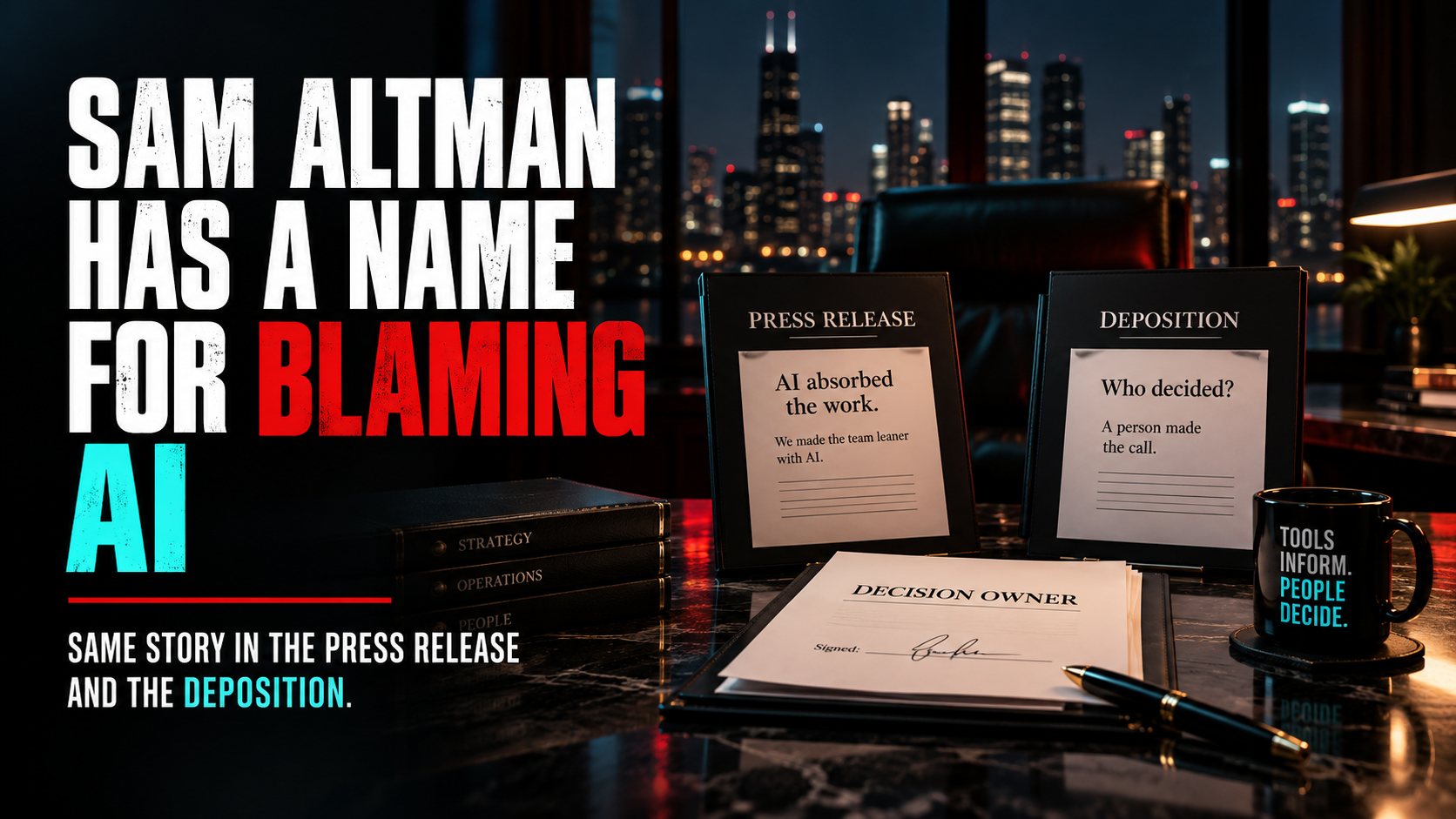
In February, Sam Altman put a name on something a lot of people had already noticed. Speaking at the India AI Impact Summit, he said some companies are AI washing, which means blaming AI for layoffs they would have made anyway. He was fair about it. He also said some of the displacement is real.
He only named half of the habit, though. The other half shows up in court. When a decision gets challenged, the same technology that was running everything in the press release suddenly never decided anything at all. Both moves do the same job. They point at the tool so nobody has to point at a person.
The cost
Start with the layoffs. Through September, Challenger, Gray & Christmas counted 120,136 announced job cuts this year that cited AI as a reason. That is about 21 percent of all cuts, and AI is still the most-cited reason for the year. Earlier this year, Forrester warned that many companies announcing AI-related layoffs do not have mature AI ready to do the work of the people they cut.
Some of those cuts are real automation. Some are ordinary cost cuts wearing a nicer jacket. From the outside you cannot tell which is which. From the inside you have to, because the stated reason becomes an input to every decision that comes after it.
Put a wrong number in cell A1 and the whole sheet inherits it. If leadership tells the board that AI absorbed the work, the board plans around savings and capacity that may not exist. The people who stayed carry the load the tool was supposed to carry. Next year's budget assumes it worked. That is the ripple effect of a reason nobody tested.
Now the other direction. In June, a federal judge in San Francisco ruled that Workday must face claims that its AI screening software filtered out job applicants in ways that violated federal disability law and California law. Back in 2024, the same court let the case move forward on the theory that employers may have handed Workday the job of rejecting or advancing candidates. Workday says the claims are false and that its tools do not make hiring decisions "in California or anywhere else." It has not been found liable. This is not a judgment on the case.
What the case shows is where the hard question lands. When an outcome gets challenged, the first thing everyone wants to know is who actually decided.
Credit when it helps, cover when it hurts
Put the two halves side by side. In the announcement, AI is the decision-maker. It made the team leaner and the roles redundant. In the courtroom, AI is a calculator. It only looked at qualifications, and a person made the call.
Let's pretend the AI is an intern. You can tell the board the intern did all the work. You can tell the judge the intern never touched the file. You cannot tell both stories, and either way your name is on the report. Whoever signs owns it.
That is the line to keep coming back to with this technology. Tools inform. People decide. A data-enabled company still has someone driving, and when the driver's name disappears from the record, the decision becomes impossible to defend.
One owner, good day or bad
The first discipline in the DARK Method is Define the Decision: what is being decided, by whom, and by when. AI washing skips the "by whom." So does "the software doesn't decide." One skips it to take the credit. The other skips it to dodge the blame.
This week brought a small counterexample. HubSpot announced it will cut about 660 jobs, roughly 7 percent of its workforce, mostly middle managers. According to LinkedIn News, CEO Yamini Rangan told employees the cuts were not the result of AI automating those jobs. You can agree or disagree with the call. Either way, the reason has a person's name on it.
That is what a defensible decision looks like. A named person owns it, the reasoning is written down before anyone knows how it turns out, and the story stays the same whether it works or blows up.
The Pressure Test: The Mirror Test
Pick one decision from this year that touched people. A reduction, a hire, a rejection, a reorg. Run it through three questions.
1. Who decided? Write down a name. If the honest answer is "the system," you do not have a decision. You have an output nobody signed.
2. Does the story survive the flip? Tell it as if the outcome had gone the other way. If it worked, would you be crediting the tool? If it ended up in front of a judge, would you be saying the tool did nothing? If the owner changes with the outcome, there was never an owner.
3. Would the record back you up? That means the criteria you set before the call, the reasoning behind it, and the person who signed off. If any of that lives only in someone's memory, it will not hold up to the first hard question.
Run it again whenever the stakes go up. A defensible decision tells the same story in the press release and in the deposition.
The close
AI can rank the candidates and draft the announcement. It cannot sign either one.
Same story in the press release and the deposition. Same owner on the good day and the bad one.
If this helped, and hiring is where your decisions carry the most weight, take a look at TruGem. It sits after your shortlist, where your hiring panel makes the call. It structures the panel's evaluation, leaves the decision with your people, and keeps a permanent record of who decided and why. You can see a demo at trugemtalent.com.
Originally published in The Decision Brief on LinkedIn.