
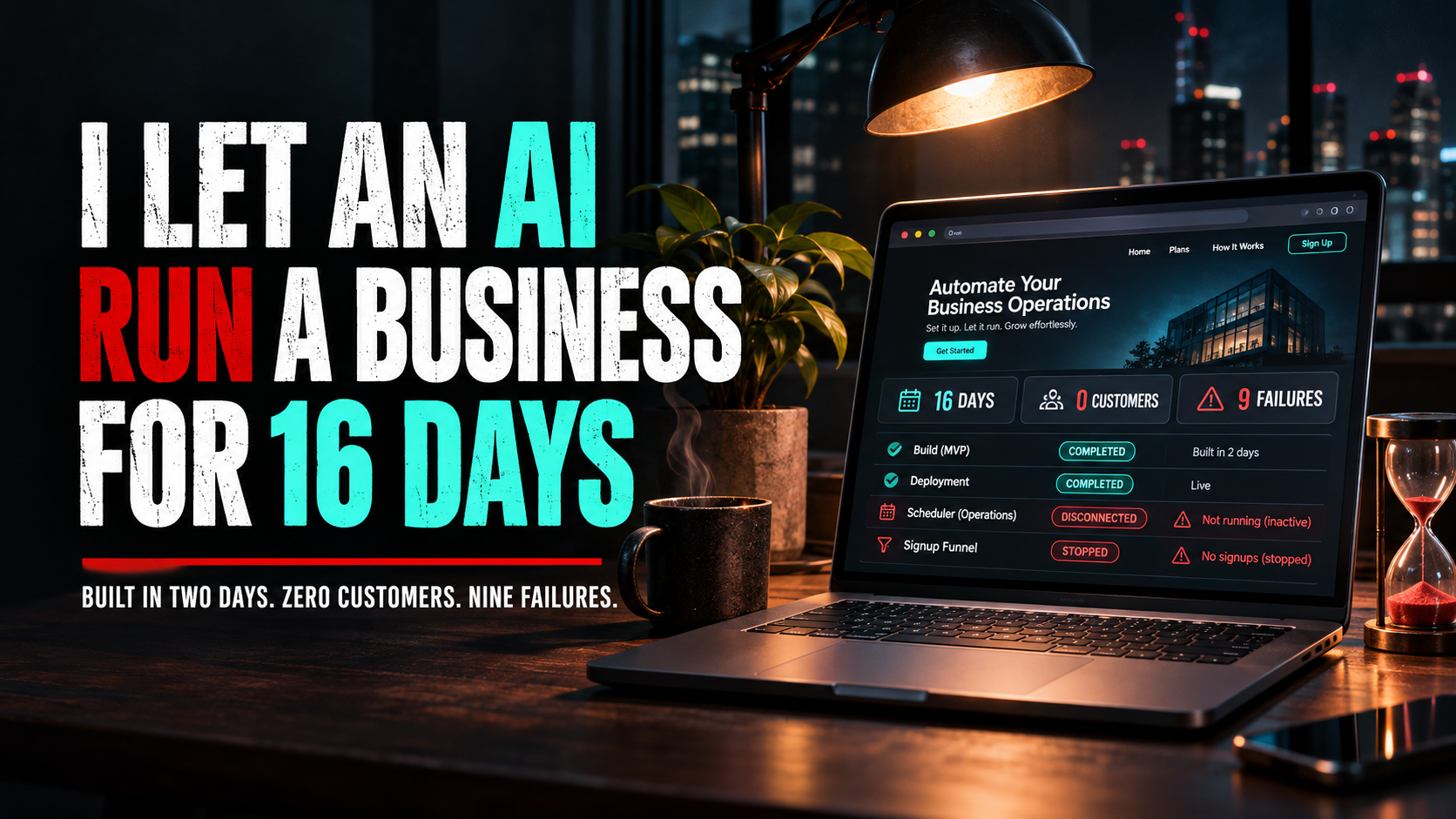
In May, an AI company called Polsia raised $30 million at a $250 million valuation on the promise of AI that runs your company while you sleep. So I tested it. For 16 days I let it build and operate a small subscription business with as little of me in the loop as I could manage. It built a working product in two days. It never found a customer, and it needed a human to step in every few days to keep it from hurting itself.
That gap between building and running is where every decision lives. And it is the part the pitch leaves out.
The cost
The business was FormCanary, a $19 to $69 per month service that checks web agencies' client contact forms and alerts them when one breaks. I set the rules before day one. A $500 monthly budget cap. Cold email only from a separate domain. A one-week ad test. A Day-30 readout to decide whether to keep it. I would step in only for money and judgment calls.
The final numbers: $195 all-in, 36 cold emails, 281 site visitors, 27 ad clicks, zero replies from prospects, zero signups, zero revenue. I shut it down on day 16.
The money was never the real exposure. The exposure was what went out under my company's name while nobody was looking. Cold emails left without the postal address US law requires, even though the address was written into the AI's instructions. The first Meta ad ran half in English and half in Spanish. Two more ads got created that nobody approved. Every one of those was caught. None of them was caught by the AI that made them.
What it got right
Credit where it is earned. Polsia went from idea to a live, billable web app in about two days: accounts, Stripe billing, three pricing tiers, legal pages, a dashboard. Plain-English change requests shipped the same day. When I reported the missing address field, their team shipped one within two days. The daily reports were candid, including when it could not verify its own fixes.
If the question is whether AI can build the first version of a business, the answer is yes, and faster than I can write a spec.
What it could not run
There were nine significant failures in 16 days. A human or a second AI I set up to check the first one caught all nine. Polsia flagged none of them first.
The worst ones made no noise at all. An internal safety rule nobody asked for quietly closed the signup page for days, while the ads and emails kept sending people to it. The scheduler behind the core product, the daily form check, stopped running for 10 days. It threw no error and sent no alert, and the daily report never mentioned that the main job had stopped.
Here is the part I still laugh about. FormCanary existed to catch exactly this kind of quiet breakage on other people's websites. The smoke detector went silent and the house never noticed.
My checker missed one too. On one check-in it reported everything running cleanly without looking at the signup page, and signup stayed closed two more days. That is the honest version. Supervision is a decision system, and decision systems need their own pressure test.
Where the human actually sits
Last week Databricks relaunched its Genie agent to work in the background on business data. Look at how it is designed. The user sets the goal and the boundaries. The agent comes back to a person only when a human decision is required. Every action runs through permissions, approval rules, and budgets, and lands in an audit trail.
That is a defensible decision design. The machine does the work. A person owns the calls, and the limits are enforced by the system, not by a sentence in a prompt.
My experiment ended up in the same place. "Hands-off" did not remove me. It moved me from doing to deciding. I ruled on money, legal, and brand. That decision layer was the only reason the thing worked at all.
The Pressure Test: The Operator Test
Before you let any AI run a piece of your business without someone watching, run it through these three questions.
- What does it do between check-ins? Write down every action it can take on its own, especially anything that spends money or goes out under your name. If you cannot list them, you cannot supervise them.
- How would you know it broke quietly? For each action, name the signal that would tell you within a day that it stopped or went wrong. If the only signal is a customer complaining, you do not have one.
- Which calls stay with a named person, and what enforces that? Money, legal, and brand at minimum. An instruction in a prompt does not count. A spending limit, an approval step, or a permission does.
If you cannot answer all three for a workflow, it is not ready to run alone. Keep the AI supporting the work or augmenting the person doing it, and come back when you can.
One more thing that saved me: I set the kill criteria before I started. The budget cap, the one-week ad test, and the Day-30 readout turned shutting down into a 10-minute decision instead of a sunk-cost debate.
The close
AI has made building cheap. It has not made judgment cheap, and the most expensive failures are the ones that make no sound.
Autonomy without a decision layer does not remove the risk. It moves the risk somewhere you cannot see it.
If you are weighing where AI should run on its own in your business, and where it should not, that is what the AI Opportunity Map is for. It ranks your AI opportunities by impact and effort, and it includes straight calls on what should not be automated. See the AI Opportunity Map.