
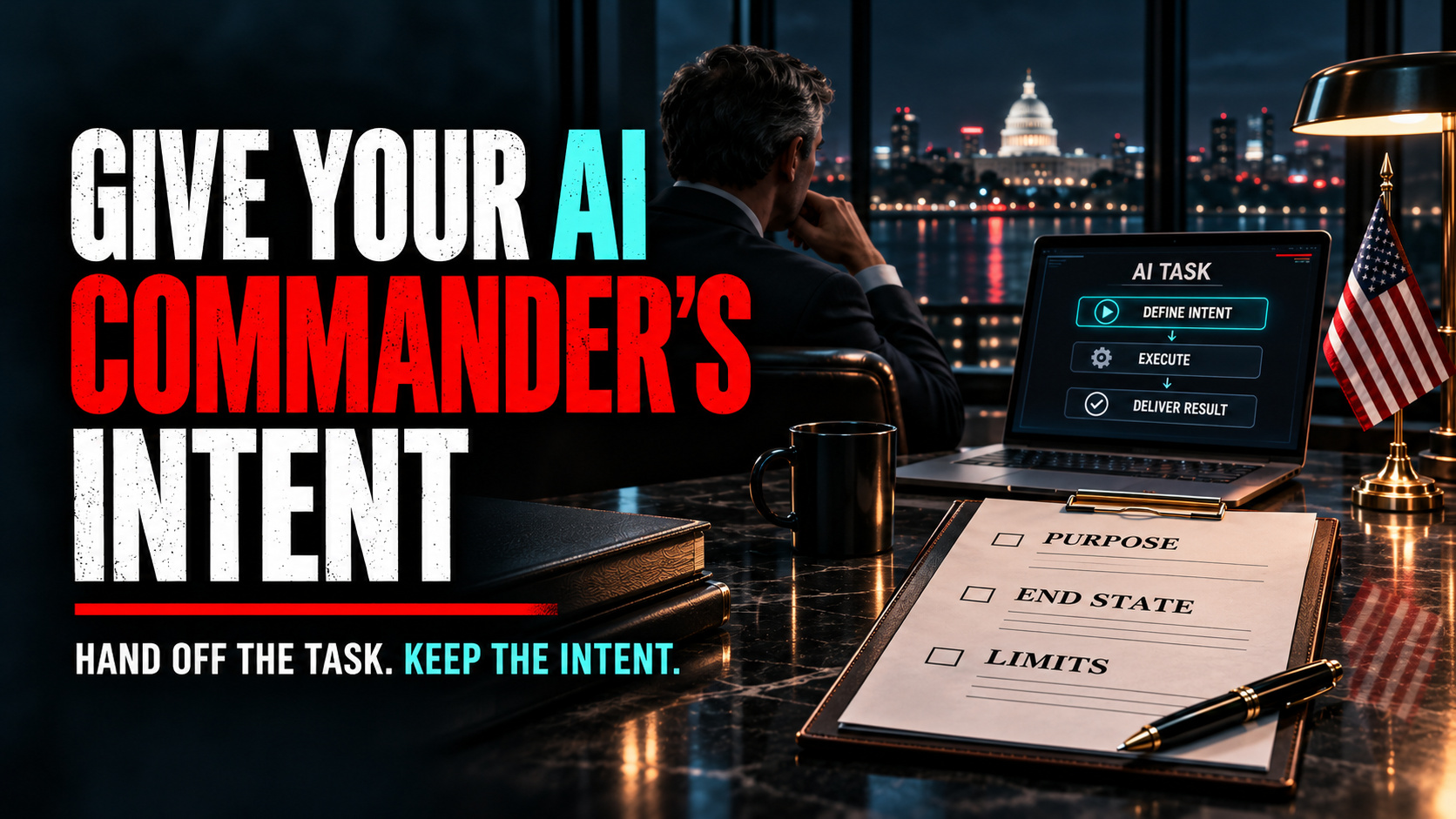
The Army learned a long time ago that orders break the moment a plan meets the real world. Its fix was a short statement called commander's intent. Most companies handing work to AI right now are giving orders with no intent behind them, and then wondering why they spend their days checking the work.
Today is Veterans Day. To everyone who served, and to the families who served beside you, thank you. This edition borrows one of the best decision tools the military ever built, because it deserves a much wider audience than it gets.
The cost
Atlassian's State of Product 2027 survey, reported by Newsweek, polled 1,000 product professionals at companies with 500 to 10,000 employees. Nearly half said they have had to check AI agents to keep them on task. Nearly half said they have had to retrace an agent's steps after something went wrong. And 69 percent said decision-making has not sped up alongside product development.
Read those together. The tools got faster. The people supervising them did not get their time back. They traded doing the work for babysitting it.
That is what orders without intent cost. Every time the situation shifts even a little, the tool has nothing to fall back on except the literal instruction. So a human steps in, re-explains, and re-prompts. Multiply that across a team and a quarter and you are paying for speed you never collect.
What commander's intent actually is
Army doctrine describes commander's intent as a clear, concise statement of the purpose of an operation and the end state it is supposed to produce. The doctrine is plain about why it exists. It lets subordinates keep acting toward the goal without waiting for new orders, even when the operation stops going to plan. Joint doctrine adds one more piece: where the commander is willing to accept risk.
Think about a new hire. Tell them "call these ten customers" and you get ten calls. Tell them "we are losing renewals in the Midwest, I need to know why before Friday's meeting, and do not offer discounts," and now they can make a good call when customer number four says something you never saw coming. Same task. Very different result, because they know what the work is for.
Plans are a guess about the future. Intent is what still holds when the guess is wrong.
Why AI makes this urgent
A prompt is an order. It tells the tool what to do. It rarely says why, what done looks like, or where the line is. That was fine when AI answered one question at a time. It falls apart once the tool is running multi-step work, pulling from your files, and making small calls along the way.
We are swimming in answers. The bottleneck has moved upstream, to whether anyone defined the decision clearly enough for a person or a tool to act on it. That is the gap the Atlassian numbers describe. Faster output, same slow decisions.
Intent stays with a human
Writing intent is a decision, and decisions belong to people. You can hand a tool the task. You cannot hand it the purpose, the definition of success, or the call on how much risk is acceptable. Those are judgment, and judgment stays with whoever owns the outcome.
Intent is also what makes a decision defensible. When something goes sideways, a written intent shows what you were trying to achieve, what you asked for, and where you drew the limits. That is a record a leader can stand behind, whether the work was done by a person, a tool, or both.
The Pressure Test: The Intent Brief
Before you delegate any decision-heavy work, to a person or to an AI tool, write three lines.
- Purpose. Why does this work exist, and what decision will it feed?
- End state. What does done look like, specific enough that someone else could tell whether it was achieved?
- Limits. What must not happen, and where are you willing to accept risk?
If you cannot write all three in five minutes, stop. The decision is not defined yet, and no tool will fix that.
Then run it against one piece of work you handed off this week.
- Could the person or tool doing it state the purpose back to you in one sentence?
- If the situation changed halfway through, would they know which way to lean without asking you?
- If it went wrong, would your instructions show where you set the limits?
Any "no" tells you where your next round of rework is coming from.
The close
No plan survives contact with reality. The military built intent so good people could still act well when that happens. Your team and your tools run into the same thing every week. Give them the purpose, the end state, and the limits, and keep the judgment for yourself.
Hand off the task. Keep the intent.
If this helped, Decision Intelligence for Leaders: The DARK Method is a two-hour workshop for leadership teams, in person or virtual, on how decisions get made and where AI should support, augment, or automate them. You'll find it at stark-analytics.com/training.