
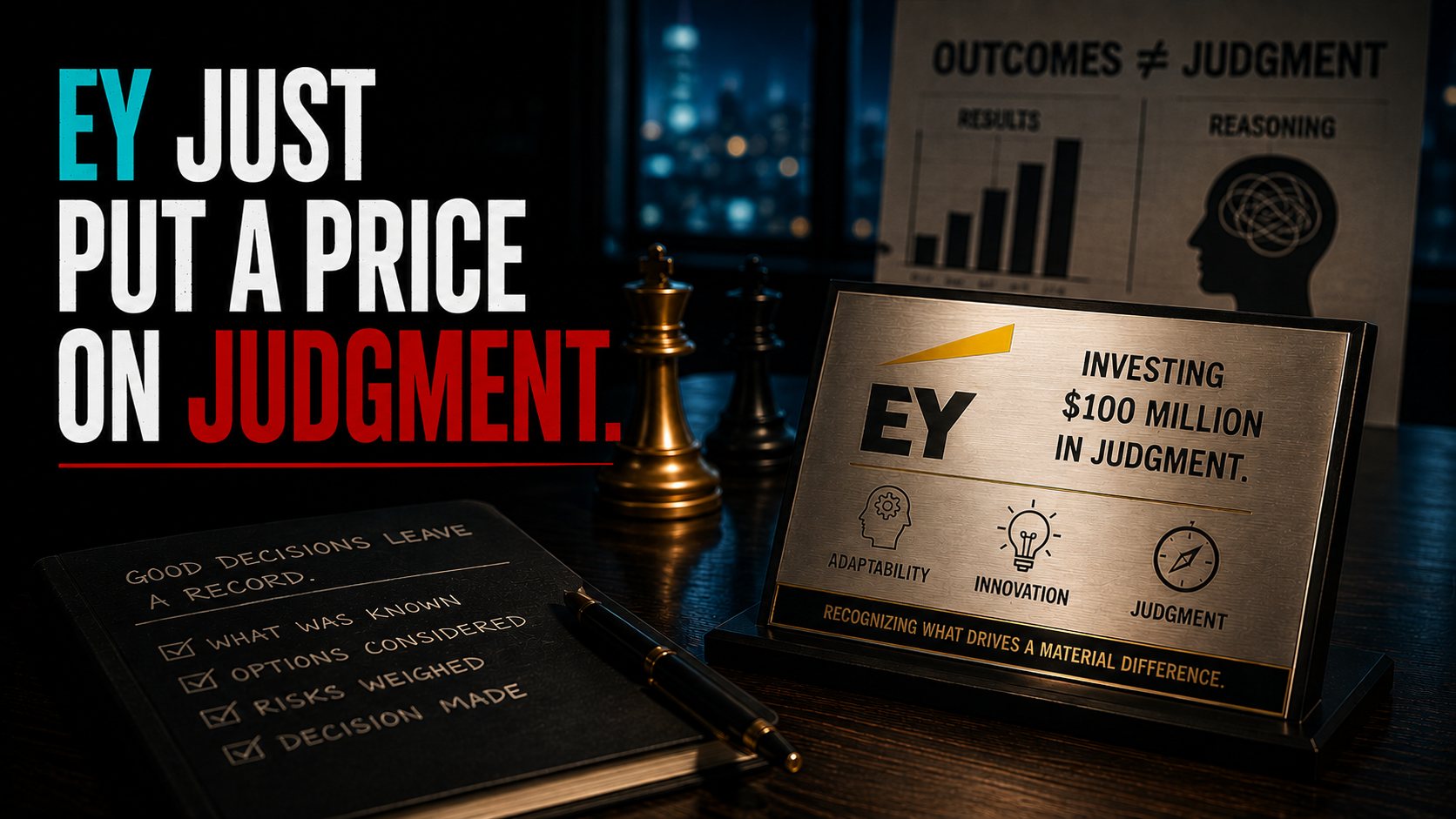
On Monday, EY announced that its US division is putting $100 million into employee rewards this fiscal year. The stated targets are adaptability, innovation, and judgment, along with experimentation with AI. Spot awards run up to $500. Individuals and teams that make a material difference to the firm can earn up to $25,000, five times the old cap.
Their talent chief said it plainly: what a firm recognizes signals what it values.
She is right, and that is exactly why the rest of us should slow down before copying this. Judgment now has a price tag. Almost nobody has a way to measure it.
The cost
Here is what happens when a company decides to reward judgment without a way to see it.
You reward outcomes and call it judgment. It is the only evidence on hand. Results are written down. Reasoning is not.
So the bonus goes to the person whose bet landed. Meanwhile the operator who talked the room out of a bad acquisition gets nothing, because the thing they prevented left no trace. A quiet quarter looks like a boring quarter. The best call of the year is often the one where nothing happened.
Then the ripple effect starts. People are not stupid. Within two cycles everyone has learned what actually pays: take the visible swing, be loud about the wins, stay quiet about the ones that missed. You wanted better thinking. You bought bigger bets and better storytelling.
A good decision and a good result are different things
Let's take AI out of it for a second.
Imagine two operators pick a supplier in the same month. The first one pulls three quotes, checks references, runs the numbers on what happens if the supplier misses a delivery window, and picks the one that holds up under that pressure. The second one goes with a name he recognized from a conference.
Six months later the careful one's supplier gets hit by a fire at their plant. The lazy one's supplier is fine.
Every scoreboard in your company says the second guy is your better decision maker. He is not. He got a good result from a bad process, which is the most expensive kind of luck there is, because it is the kind that gets repeated.
Judgment is about the quality of the call at the moment it was made, with what was actually knowable then. Results are about everything that happened afterward, most of which nobody controlled. Paying for one and measuring the other is how good process quietly leaves your company.
Hindsight eats the evidence
The reason companies default to outcomes is not laziness. It is that reasoning disappears.
Ask someone in November to explain a call they made in March and you will not get March back. You will get March rewritten by everything that happened since. People remember being more certain than they were. They remember considering options they never actually raised. The risk that showed up feels obvious in the retelling, and the four risks that never materialized are gone completely.
This is where AI is quietly making it worse. More of the thinking now happens in a chat window, in a session nobody saved, in an account the company does not own. The output gets pasted into a deck. The reasoning evaporates. And then a year later somebody tries to evaluate the judgment behind a decision and all they have is the deck and the result.
You cannot reward what you cannot see. If judgment is going to be worth money, it has to leave a record while it is happening. Written before the outcome, not reconstructed after it.
The Pressure Test: The Good Call Test
Run this on any decision you are about to praise or punish. Three questions, five minutes.
1. What did they actually know when they decided? Not what you know now. What was on the table that week. If you cannot answer this without guessing, you are not evaluating judgment. You are grading the weather.
2. What did they consider and rule out, and why? A real decision has rejected options behind it. If nobody can name what else was on the table, there was no decision. There was a preference that got approved.
3. Would this still have been the right call if it had gone the other way? This is the whole test. If yes, it was a good call that lost, and it should be defended out loud in front of the team. If no, it was a bad call that won, and it should be corrected quietly before anyone learns the wrong lesson from it.
Anything that clears all three is a defensible decision. Structured, recorded, and owned by a person who can explain it.
The close
EY is doing something most firms will not do, which is say out loud that human judgment is the asset worth paying for. That is the right read of where this is going.
The part nobody has solved is the measurement. If you want to pay for judgment, you have to build the record first. That means capturing what was known, what was weighed, and what was rejected, at the time, before the result comes in and rewrites everyone's memory.
Otherwise you are not rewarding judgment at all. You are running a lottery with a performance review attached.
Record the reasoning. Judge the call, not the coin flip. Pay for the thinking you can actually see.
Want to see how much of a real decision you have examined versus assumed? Take one apart, layer by layer: https://www.stark-analytics.com/resources/decision-anatomy-worksheet
Originally published in The Decision Brief on LinkedIn.