
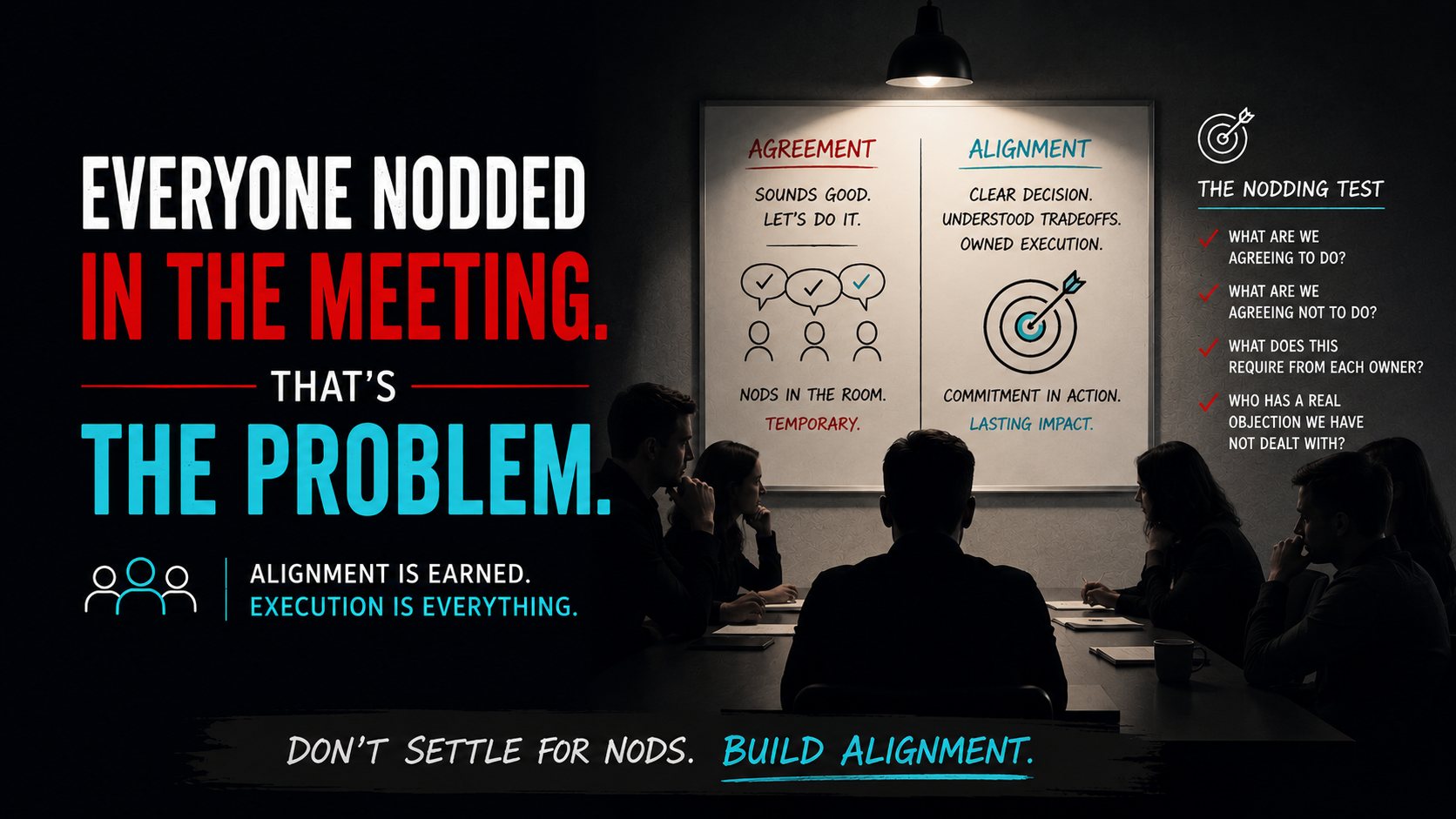
A room can agree without aligning... That is what makes nodding dangerous. It gives the leader the feeling of consensus before the decision has actually survived friction.
The decision sounds agreed upon. The meeting ends cleanly. The notes go out. Everyone leaves with the sense that the room is on the same page.
Then execution exposes what the meeting covered up.
The cost
The pattern is easy to miss because it looks professional while it is happening.
A decision gets discussed. People ask polite questions. Nobody pushes hard. The room stays calm. The meeting ends without tension, which feels like a win.
Then the work starts.
A manager quietly delays their part. A team member keeps using the old process. A partner reopens the debate in a side conversation. Someone who nodded in the meeting starts saying, "I just want to make sure we're thinking this through."
That usually means they did not agree. They complied.
There is a difference.
Visible agreement is cheap. Real alignment is expensive because it requires friction before commitment. Someone has to name the tradeoff. Someone has to say what the decision rules out. Someone has to admit what they still do not believe, even if they are willing to move forward.
Teams avoid that friction for understandable reasons. They want the meeting to go smoothly. They want to preserve the relationship. They want the decision to feel clean. They want to leave the room with momentum.
So they trade real tension now for hidden resistance later.
That trade usually costs more.
The decision slows down. Execution gets patchy. Accountability gets weird. People start defending their interpretation instead of executing the actual call. The leader is left wondering why everyone agreed but nobody moved the same way.
The answer is simple: They did not align. They performed agreement.
Agreement is not alignment
Agreement is verbal. Alignment is operational.
That is the distinction leaders have to protect.
In the DARK Method, Align is not about getting everyone to like the decision. That is approval-seeking. Alignment means the decision connects to the direction of the business. The constraints are visible. The tradeoffs are understood. The people responsible for execution know what is being chosen, what is being rejected, and what their part actually requires.
That last part matters because every real decision rejects something.
If you decide to pursue one market, you are deciding not to pursue another with the same energy. If you decide to protect margin, you are deciding not to win every deal. If you decide to simplify delivery, you are deciding not to customize every request.
A decision that costs nothing is usually not a decision yet.
It is an intention.
That is why nodding can be so misleading. People can agree with the intention while disagreeing with the cost. They can agree with the goal while resisting the behavior change. They can agree in the room while planning to keep doing what already feels safe.
The meeting did not create alignment. It created the appearance of it.
And appearances do not survive execution.
The Pressure Test: The Nodding Test
Use this before you leave the room on any decision that requires other people to execute.
Not after. Before.
1. What exactly are we agreeing to do?
Make someone state the decision plainly.
Not the topic. Not the intention. Not the general direction. The actual decision.
"We need to improve client experience" is not a decision.
"We are going to reduce custom client requests by moving all new clients into one of three standard service paths starting next month" is a decision.
If three people give three different answers, the room is not aligned. The conversation is still open.
2. What are we agreeing not to do?
This is the question that separates agreement from alignment.
A decision without tradeoffs is probably still a preference. If the room cannot name what is being rejected, delayed, deprioritized, or risked, the decision is not mature yet.
Ask it directly.
What are we saying no to by saying yes to this?
That question will make the room less comfortable. Good. Comfort is not the goal. Clarity is.
3. What does this require from each owner?
A decision does not become real until ownership is specific.
Who changes behavior? Who stops doing something? Who communicates the decision? Who absorbs the friction? Who has authority to enforce it when the old pattern tries to come back?
If the answer is "the team," nobody owns it.
Name the people. Name the actions. Name the timing.
4. Who has a real objection we have not dealt with?
Do not ask, "Is everyone good?"
That question invites politeness.
Ask for the objection.
What concern has not been said yet? What part of this decision feels weak? What are we pretending is more settled than it actually is?
Then pause longer than feels comfortable.
Silence is often where the real answer starts trying to get brave.
If an objection surfaces, do not punish it. Pressure-testing is not disloyalty. It is how the decision gets stronger.
The point is not to let every objection kill the decision. The point is to make sure the decision has actually survived the objections that matter.
That is what alignment costs.
The close
Agreement is what people give you when they want the meeting to end.
Alignment is what you get when the decision has been made clear enough, challenged enough, and owned enough to survive execution.
Those are not the same thing.
The room can nod and still be misaligned. The room can argue and leave stronger.
The second room is the stronger choice every time.
If you want a simple way to measure how much real pushback your decisions get before commitment, use the FREE Blind Spot Test. It gives you an honest read on whether your decision-making process is being challenged or whether you are mostly running alone.
Run it on the last big decision your team made. The score will tell you more than the meeting did.
Originally published in The Decision Brief on LinkedIn.