
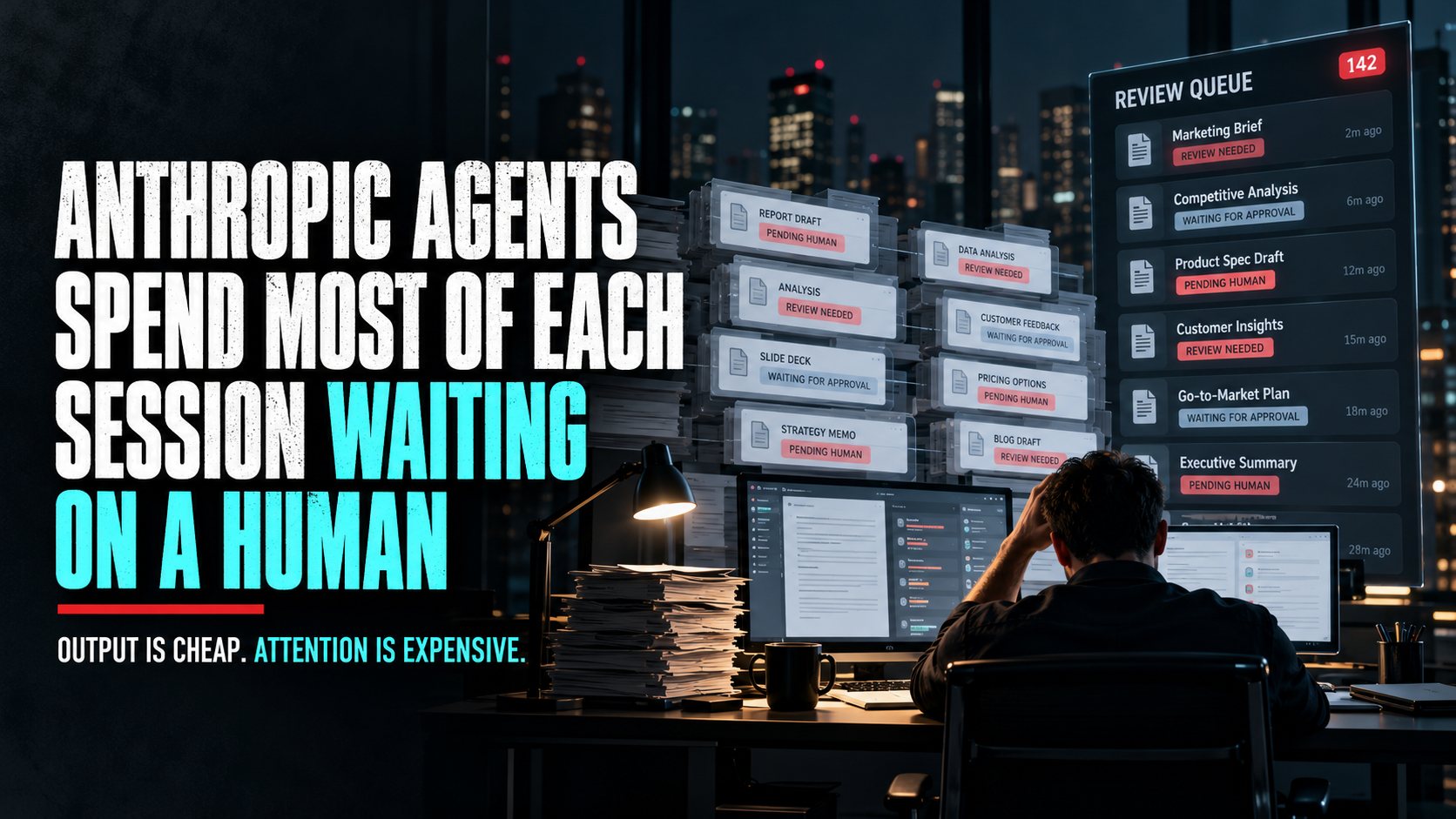
Anthropic just published a report on how AI changed work inside its own company, and the most useful number in it has nothing to do with the model. In interactive sessions, its agents spend roughly 80 percent of the elapsed time waiting on a person to respond.
Sit with who is saying that. This is the company that builds the agents, running them about as hard as anyone can. The report's own conclusion is that human attention has become the bottleneck for agent output. If that is true there, it is true in your business. The difference is they measured it.
The cost
The report, published October 16, describes a workforce buried in output. By August, agents at the company were logging about six times the working hours of the people. The share of employee sessions spent managing agents, rather than doing the work, climbed from 10 percent to 22 percent. One engineer described the job as facing "an army of Claudes, with every one asking for my attention."
That is the cost nobody puts in the AI business case. When output gets cheap, review gets thin. The pattern is predictable. Everything gets the same quick skim, so nothing gets the right amount of attention. A pricing change, a candidate rejection, and a social caption all clear the same quick glance, and approval turns into a click.
And the click has a name on it. When that pricing change goes sideways, nobody asks what the agent was thinking. They ask who approved it. A decision you skimmed is a decision you can't defend.
Judgment is the scarce resource now
AI flipped the economics of work. Output used to be scarce, so we built processes to produce more of it. Now output is abundant and judgment is scarce, and the review habits in a lot of companies never caught up.
Think about the spreadsheet. You don't audit every cell in a 40-tab model. You audit the cells that feed the total, because a bad input in cell A1 ripples through every formula downstream. Everything else gets a sanity check. Nobody calls that lazy. They call it knowing where the risk lives.
Agent output deserves the same treatment. The tempting fix for the bottleneck is to approve faster or stop reading altogether. That clears the queue by removing the judgment, which is the one part of the system you can't afford to lose. The machine produces. The human decides. That line doesn't move.
The better fix is to decide, before the output shows up, where your attention goes. Treat it like a budget, because that's what it is. You have a fixed amount. Every hour spent rereading a low-stakes draft is an hour pulled away from the decision that can actually hurt you.
The Pressure Test: The Attention Budget
Take every recurring piece of work your agents produce and sort it into one of three tiers.
- Decide. A named person reads it in full and owns the call. This tier is for work that is hard to undo, expensive if wrong, or that someone will have to explain later.
- Spot-check. A human samples it on a fixed rhythm, like every fifth item or every Friday. Medium stakes, reversible with some pain.
- Release. It ships under a rule a human wrote, without line-by-line review. Low stakes, cheap to undo. The rule itself gets reviewed on the calendar.
To sort any item, run three questions.
- Can it be undone cheaply? If not, it doesn't belong in Release.
- Who answers for it if it's wrong? If you can name the person, it belongs in Decide, and that person reads it.
- What does being wrong cost, and who else feels it? If the ripple reaches a customer, a candidate, or the bank account, move it up a tier.
One rule keeps the budget honest. Items move up a tier on a hunch. They only move down with evidence.
Run it again every month. If you catch yourself skimming something in the Decide tier, the budget is overspent. The fix is to move work out of Decide on purpose. Reading faster only hides the problem.
The close
Anthropic's report reads like a preview of where a lot of companies are headed. The agents will keep getting faster. Your attention won't. The companies that make defensible decisions in that world will be the ones that decided in advance where their judgment goes.
Output is cheap. Attention is expensive. Spend it where the decision lives.
If this helped, the Decision Intelligence Assessment is a free, 12-question check on how your decisions actually get made. It takes about five minutes. You'll find it at stark-analytics.com/resources.
Originally published in The Decision Brief on LinkedIn.