
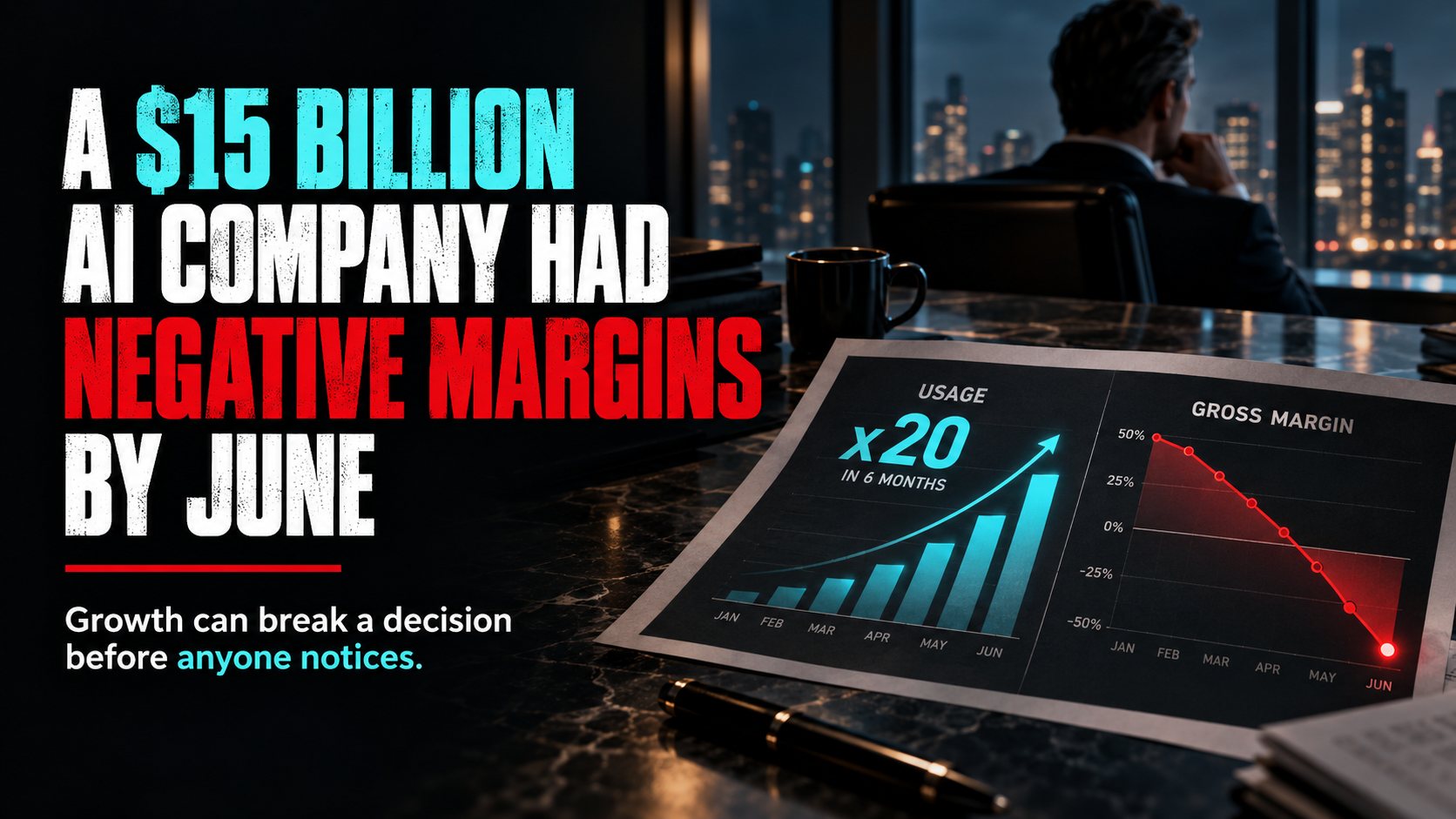
Harvey is one of the most successful AI companies in the world. Law firms use it to draft, research, and review. It is valued at $15.6 billion.
Bloomberg reported on September 21 that Harvey's gross margins went from roughly 50 percent at the start of 2026 to negative 50 percent by June. Its AI token usage rose about twentyfold over the same stretch.
Read that again. The company did not lose customers. Customers used the product more, and that is what nearly broke it.
The cost
Harvey was built on top of models rented from the big AI labs. That was a smart call when it was made. Renting got them to market fast, with frontier quality, without building a lab of their own.
But every rented model call costs money. At one level of usage, that cost fits inside a healthy margin. At twenty times that usage, the same arrangement means selling the product below cost. The decision did not change. The volume did, and the decision quietly stopped being true.
Harvey caught it and fixed it. In August it released its own custom model, built on an open model from Moonshot AI, and per Bloomberg its margins are positive again. Other AI startups, including Decagon and Abridge, are making similar moves.
So this is not a story about a company that got it wrong. It is a story about a decision that was right at one size and wrong at another, and how long it takes to notice the difference.
Every decision has a size where it breaks
Think about a business like a spreadsheet. Change one input and the whole sheet recalculates. The problem is that most decisions get made once, at one set of inputs, and then nobody reruns the model when the inputs move.
You see it everywhere once you look for it:
- The supplier contract that made sense at 500 units a month and quietly eats your margin at 5,000.
- The pricing that worked for twenty customers and collapses under two hundred.
- The one-person approval step that was fine at ten requests a week and becomes the bottleneck at a hundred.
- The software seat plan that was cheap for a team of eight and costs more than a hire at eighty.
None of these were bad decisions. Each one was made for a size of business that no longer exists. And none of them come with an alarm. They just show up one day on the P&L, already expensive.
This is what it means to run the ranges. A decision is never just the call. It is the call plus the range of conditions it holds inside. Make the call without naming the range and you have made a bet with no end date.
Growth makes this worse
Here is the uncomfortable part. The better things go, the faster this happens.
A struggling business rarely outgrows its decisions, because nothing is changing size. A growing business outgrows them constantly. More customers, more volume, more usage, more headcount. Each one pushes some old decision past the point where it was designed to work.
And growth is exactly when leaders stop checking. Revenue is up, the team is busy, and nobody wants to be the person asking whether last year's vendor deal still makes sense. Success buys a lot of silence.
Harvey's usage climbing twentyfold is the kind of number every founder dreams about. It was also the number that pushed a good decision past its breaking point.
The Pressure Test: The Scale Test
Pick one recurring decision your business still runs on: a vendor, a price, a staffing model, an approval step. Run these three.
1. At what volume does this decision break? Name the number. The unit count, the customer count, the usage level where the math stops working. If you cannot name it, you do not understand the decision yet. You just know it is working today.
2. Where are we today, and how fast are we moving toward it? Put your current number next to the breaking point. Then look at the trend. A decision at half its limit and growing twentyfold a year is closer to breaking than one at ninety percent and flat.
3. Who finds out before we cross it? Name the person and the trigger. Not the quarterly review. A specific number that, when crossed, puts this decision back on someone's desk. If nobody is watching the line, the P&L will tell you, and it will tell you late.
A decision that clears all three is a defensible decision. Made on purpose, with its limits written down, and owned by someone who will know when those limits are near.
The close
Harvey did not make a bad decision. It made a good decision for a company one twentieth its size, and then it grew.
The same thing is happening inside your business right now, in some contract or price or process nobody has looked at since it was signed. The fix is not to decide better once. It is to write down where each decision stops working, and to put someone on watch.
Name the range. Watch the line. Rerun the model before the numbers force you to.
Harvey found its breaking point on the P&L. You can find yours on paper first. The Decision System Blueprint takes one recurring decision in your business and turns it into a documented system, with its limits written in. Backed by two written guarantees, and the fee is credited if you build it: https://www.stark-analytics.com/stark-decision-system-blueprint
Originally published in The Decision Brief on LinkedIn.